
During my college years, I transitioned from exclusively gaming on computers like the Commodore 64 and Amiga. In so doing, I found myself drifting toward the underdog systems of the time, like the Sega Master System and, eventually, the Atari Jaguar. Another underdog system that I took under my wing was NEC’s TurboGrafx-16. While the system was quite popular in its native Japan (where it was known as the PC Engine), it enjoyed limited success in the States. It’s unfortunate that NEC simply couldn’t compete with the likes of Sega’s Genesis and, eventually, Nintendo’s SNES, because the TG-16 had some killer games of its own. Games like Devil’s Crush, Soldier Blade, and Splatterhouse could definitely hold their own against the best that the Big Two put forward. With the addition of the CD-ROM drive and the System 3.0 “Super CD” Card, titles like Gates of Thunder and Castlevania: Rondo of Blood have become iconic NEC releases and are widely regarded as some of the best games of their respective eras.

Space Harrier for the PCE
I find it interesting that Sega would then agree to license some of their most popular arcade titles to NEC for inclusion on their competing platform. But that’s exactly what happened. Six classic arcade titles eventually made their way to the PC Engine in Japan, with only two of them reaching North American audiences. Space Harrier, Fantasy Zone, Out Run, After Burner II, Thunder Blade, and Juuouki (Altered Beast in the US) would all be released in Japan, with only Space Harrier and Fantasy Zone being localized for English-speaking audiences.
The conversion of these classic arcade titles was handled in-house by NEC Avenue. In addition to the aforementioned Sega titles, the group was responsible for Taito-licensed ports of the Darius series of popular side-scrolling piscine-themed shooters, released not only for the CD-ROM and Super CD-ROM, but also for the short-lived SuperGrafx system. They also managed superb ports of Capcom staples Ghouls ‘n Ghosts and Forgotten Worlds. Suffice it to say, NEC Avenue knew how to successfully port arcade hits.
Let’s take a closer look at these six Sega ports and see how they stand up to their arcade originals.
Space Harrier
The first of two titles that graced American screens, Space Harrier is one of Sega’s “Super Scaler” games. These titles used hardware sprite scaling to create a pseudo-3D effect. Combined with the absolute breakneck speed at which these games ran, it was very effective in achieving that 3D effect. We wouldn’t see true scaling versions of any of these titles until the ill-fated Sega 32X Genesis add-on, which featured near-arcade-perfect ports of both After Burner (released as After Burner Complete) and Space Harrier. The various ports of Space Harrier to non-scaling systems of the era produced mixed results, ranging from “simply awful” to “Are you sure this isn’t scaling?” Fortunately, the TG-16 version of the game falls directly into the latter category. The game moves quickly, and your protagonist is very responsive to the controls. There are enough frames of manually-scaled sprites that the sense of scaling at speed is very evident. The music is catchy, if notably different than the arcade, and the vocal samples make the transition, even if they are a bit scratchier than the originals. All in all, it was a good choice to localize for the US.

Fantasy Zone for the PCE
Fantasy Zone
The second of the only two titles to make it over here is the cute ’em up Fantasy Zone. The fact that this is not one of Sega’s Super Scaler titles definitely works in the console’s favor and is probably the most PC Engine-friendly of the six ports. The graphics are shrunk a bit, and you lose the parallax scrolling backgrounds, but the game still looks the part, with a colorful palette and adorable enemies intent on wiping you out. On that subject, the adversaries here seem particularly keen on seeing you snuff it, since the game was tuned to play harder than the arcade original. Not a usual turn for games that were originally written to gobble as many quarters as possible in the arcade, but Fantasy Zone on the TG-16 will give you a run for your money anyway.
Out Run
Back to the Super Scalers with the PC Engine version of the classic racer, Out Run. We wouldn’t see this title, or the remaining three conversions, in the US, which is a shame, since this one in particular is an excellent port of the arcade original. Once again, the developers cram a ton of sprite data into the HuCard, providing a superior faux-scaling presentation. Unfortunately, to save on memory and CPU cycles, the track-side graphics are somewhat sparser than in the arcade. It’s not a deal-breaker, but it is noticeable. The iconic music arrives intact, though slightly tuned, with a PC Engine-esque quality. Unfortunately, your engine sound is not so lucky, appearing as an irritatingly loud scream throughout the game. Luckily, it can be turned off in favor of a shower of musical sounds. A nice, if slightly flawed, port of an iconic racer.

After Burner II for the PCE
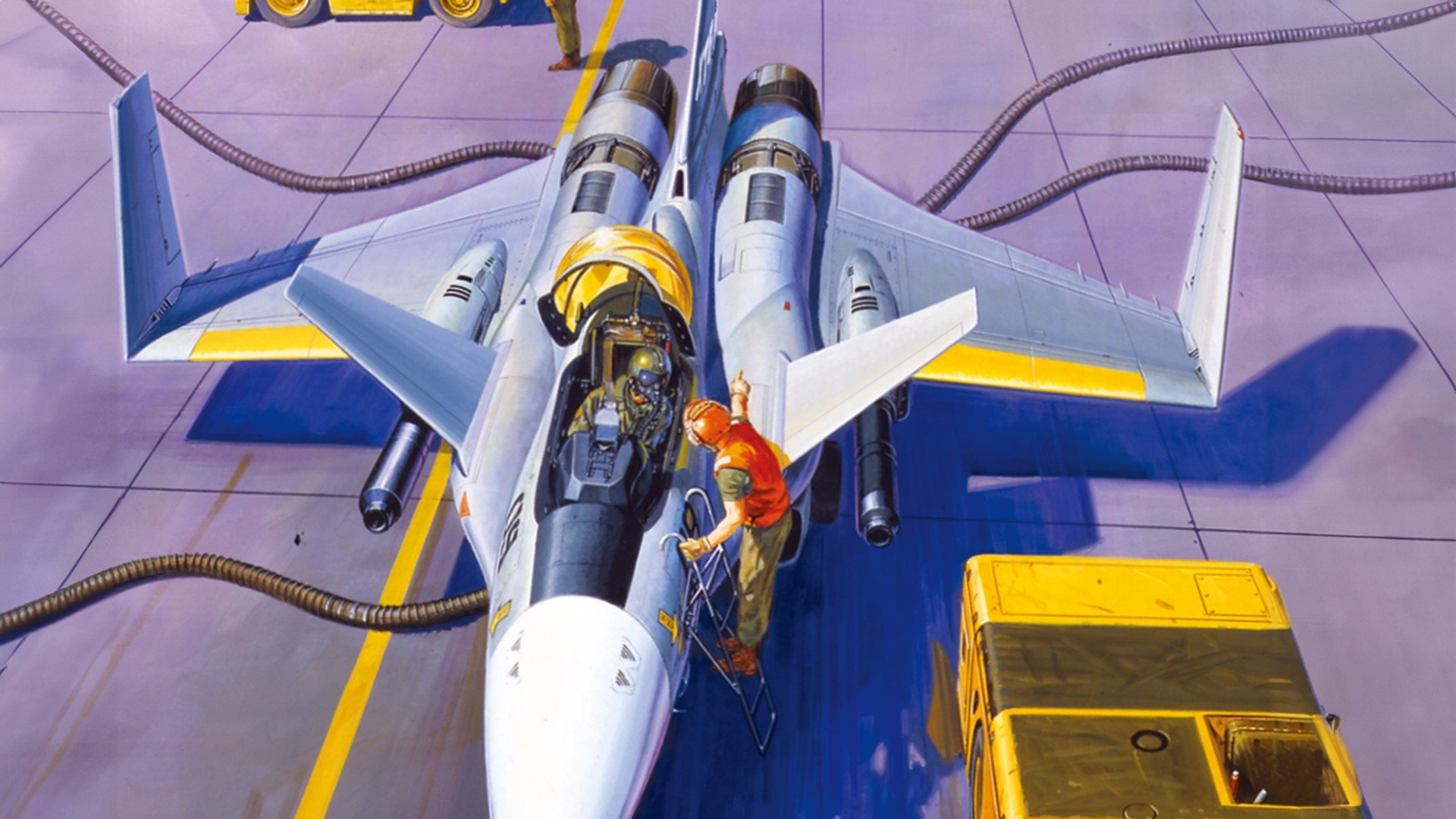
After Burner II
The game that made every one of us feel like Maverick from Top Gun for 50 cents. After Burner II was the pinnacle of flight combat games in the arcade for a while. Tight controls, frenetic action, and a killer soundtrack, not to mention your RIO constantly yelling “LOCK!” every time to lock onto an enemy aircraft. It was an experience that was difficult to replicate at home. Like the rest of the Super Scaler games, it was attempted with varying levels of success. NEC Avenue managed to recreate much of that arcade feel with the PC Engine version of the game, releasing a port that was nearly as good as their Space Harrier version. The sense of speed and action remained, as did the speech samples. The scaling effect is, once again, impressive for the limitations of the HuCard. The music, while still high-energy, loses some of the kick and punch of the original tracks in the translation to the PC Engine hardware. The backgrounds, while smoothly animated, like Out Run, are noticeably sparse. The limitations of the graphics are even more apparent in the canyon levels, which unfortunately turn into a bit of a muddled mess. Fortunately, it doesn’t detract too much from the overall experience. A capable port of an iconic Sega staple.
Thunder Blade
Of all of the Super Scaler ports to the PC Engine, Thunder Blade is by far the weakest. The arcade game was a unique blend of 3D scaling and classic top-down shooter gameplay, with smooth transitions between sections. Along with the force-feedback controls, it was a unique experience that was always going to be a tough sell at home. Unfortunately, NEC Avenue dropped the ball when porting Thunder Blade to the PC Engine. While Out Run and After Burner II had sparse backgrounds, Thunder Blade’s are practically devoid of anything, save a few cookie-cutter buildings. And what is there is a bit of a mess. The motion is jerky and difficult to control, and the overhead stages are an absolute slog. There’s really very little to recommend with this port. Not a huge disappointment that this one stayed in Japan.

Altered Beast for the PCE
Jūōki (Altered Beast)
This one is the oddball among the other Sega arcade ports. It’s not a scaler, and it’s not a shooter. Jūōki (Altered Beast outside of Japan) is a side-scrolling brawler, where you play a man with the ability to transform into different beastly forms, each with its own powers and play style. The arcade version had large, detailed character graphics and rich environments. From the initial command to “rise from your grave”, the screen pushes you forward to the end of the level. Along the way, you can collect power orbs that slowly transform you into your final beast form. You face a boss at the end, and if you beat the boss, you are stripped of your powers and sent to the next level, where you start all over again. The game would be brought to the Sega Genesis as the original pack-in title (prior to the juggernaut known as Sonic). While NEC Avenue’s attempt to bring the game to the PC Engine isn’t as good as Sega’s Genesis port, it stands on its own. Graphics lose some fidelity, but are still large for the platform. Like Fantasy Zone, the difficulty is turned up to eleven here, at least for the HuCard version. There was also a CD-ROM version of the game released, which included a difficulty setting and speech samples from the original arcade game, but no noticeable improvements in graphics or sound. Even though it stands as the odd man out of the six titles, it definitely deserves a place in the NEC library.
Given that they were competing for the same audience, it is definitely odd to see Sega put some of its most popular arcade IPs at the time on the PC Engine/TurboGrafx-16, but the result is five games that deserve a home in any retro library, and one that is better left on foreign shores.
The post Sega on NEC: Arcade Classics on the PC Engine and TurboGrafx-16 appeared first on Old School Gamer Magazine.