




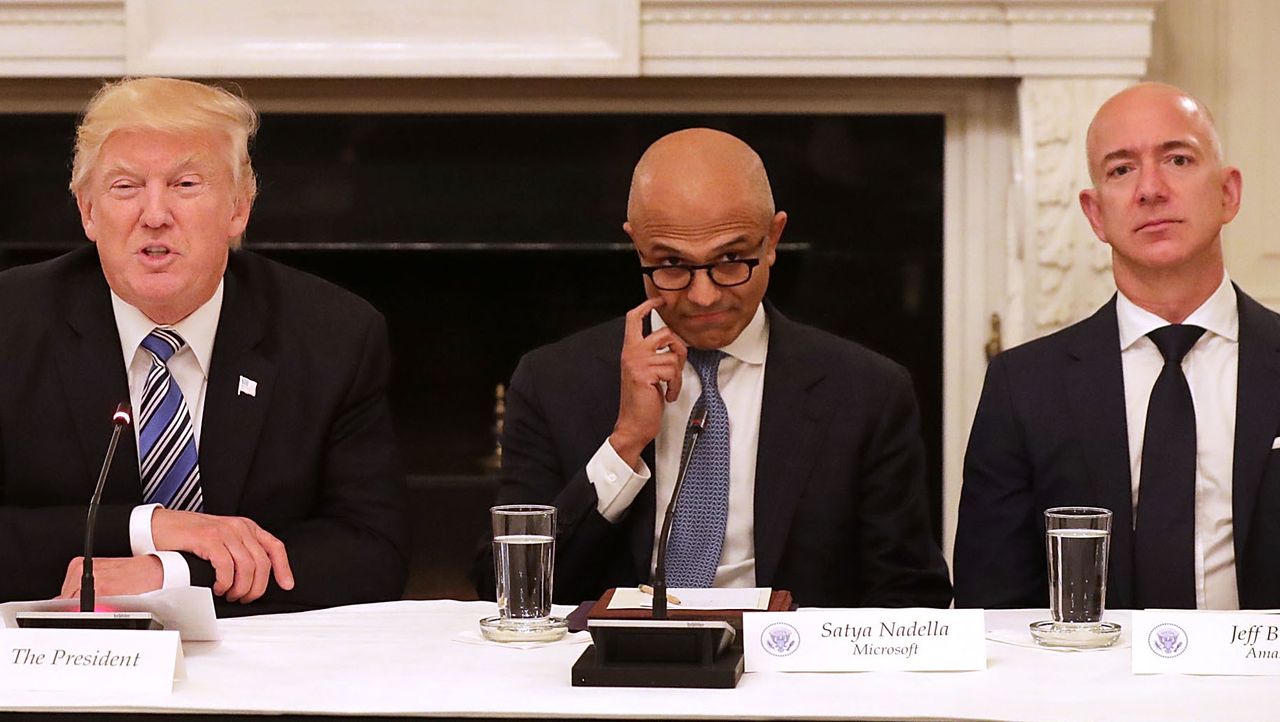
Google, Microsoft, Meta, Amazon and “several artificial intelligence companies” signed a pledge at the White House yesterday, dubbed the “Ratepayer Protection Pledge,” to pay for the cost of powering their data centres, the Guardian reports. But there are questions over the legal authority of the pledge and what it will amount to in practice.
The move reflects concerns in the US that the proliferation of data centres, driven largely by AI, is driving up the cost of electricity for home owners and businesses. “President Trump is calling on the leading United States hyperscalers and AI companies to build, bring, or buy all of the energy needed for building and operating data centers, paying the full cost of their energy and infrastructure, no matter what,” the White House statement on the Pledge said.
“This means that the tech companies and the datacenters will be able to get the electricity they need, all without driving up electricity costs for consumers,” President Donald Trump said.
“This is a historic win for countless American families and we’ll also make our electricity grid stronger and more resilient than ever before.”
The pledge commits participating tech companies to pay for new or expanded power plant capacity and also to sign up to special rates for power supplies.
The pledge includes a commitment by technology companies to bring or buy electricity supplies for their datacenters, either from new power plants or existing plants with expanded output capacity. It also includes commitments from big tech to pay for upgrades to power delivery systems and to enter special electricity rate agreements with utilities.

Notably, this includes tech companies paying those rates even if they don’t actually use the power. “This will protect the American people from increased utility bills as a result of the development of these data centers,” the White House said.
Meta, for one, is bigging up its role in energy supply and use, saying, “We pay the full costs of our data centers’ energy and water use so they aren’t passed on to consumers, and fund new and upgraded infrastructure.”
In terms of who the other signatories were at the White House event, Oracle, xAI and OpenAI are reported to have been in attendance, but the White House release didn’t include a full list.
It’s also not clear what legal authority the “Pledge” carries. In a “Proclamation” concerning the Pledge, the President says that the “Ratepayer Protection Pledge and the commitments embodied therein effectuate the national policy of the United States…by virtue of the authority vested in me by the Constitution and the laws of the United States.”
However, the Proclamation cites no specific statute or constitutional provision as the source of that authority. As things stand, then, it’s hard to say what mechanism could be used to enforce signatories to meet their Pledge commitments.
It’s worth noting that a Presidential “Proclamation” is not the same as an Executive Order. The latter essentially instructs federal agencies, departments, and officials on how to implement policy or interpret law and has much clearer legal authority, though still bounded by the Constitution.
That said, and by way of example, Trump has used both Executive Orders and Proclamations to implement tariff policy. It’s just that this particular Proclamation is particularly thin when it comes to laying out its legal and constitutional standing.
So, we’ll have to wait and see if this amounts to genuine actions by the tech firms in question, or if perhaps this is more about political positioning as the US mid-terms approach later this year.