

At Fate’s End: Hands-On with Thunder Lotus’ Gorgeous New Action-Adventure
Most people know Thunder Lotus games for Spiritfarer, their beautiful 2020 management sim about shepherding the newly dead to the other side. That cozy style of gameplay is actually more of an outlier from their mostly action-based catalogue, however. They’ve been on my radar since their first game, 2015’s Jotun, and the one unifying trait across all of their work is gorgeous, hand-drawn 2D animation.
Thunder Lotus’ latest, At Fate’s End, combines the heartfelt, character-centric writing of Spiritfarer with their deep bench of action experience to make something special, and both elements serve as showcases for the studio’s most stunning animation work yet. I got early hands on the GDC demo to experience about an hour and half of the game’s beginning, and I can’t wait for more.
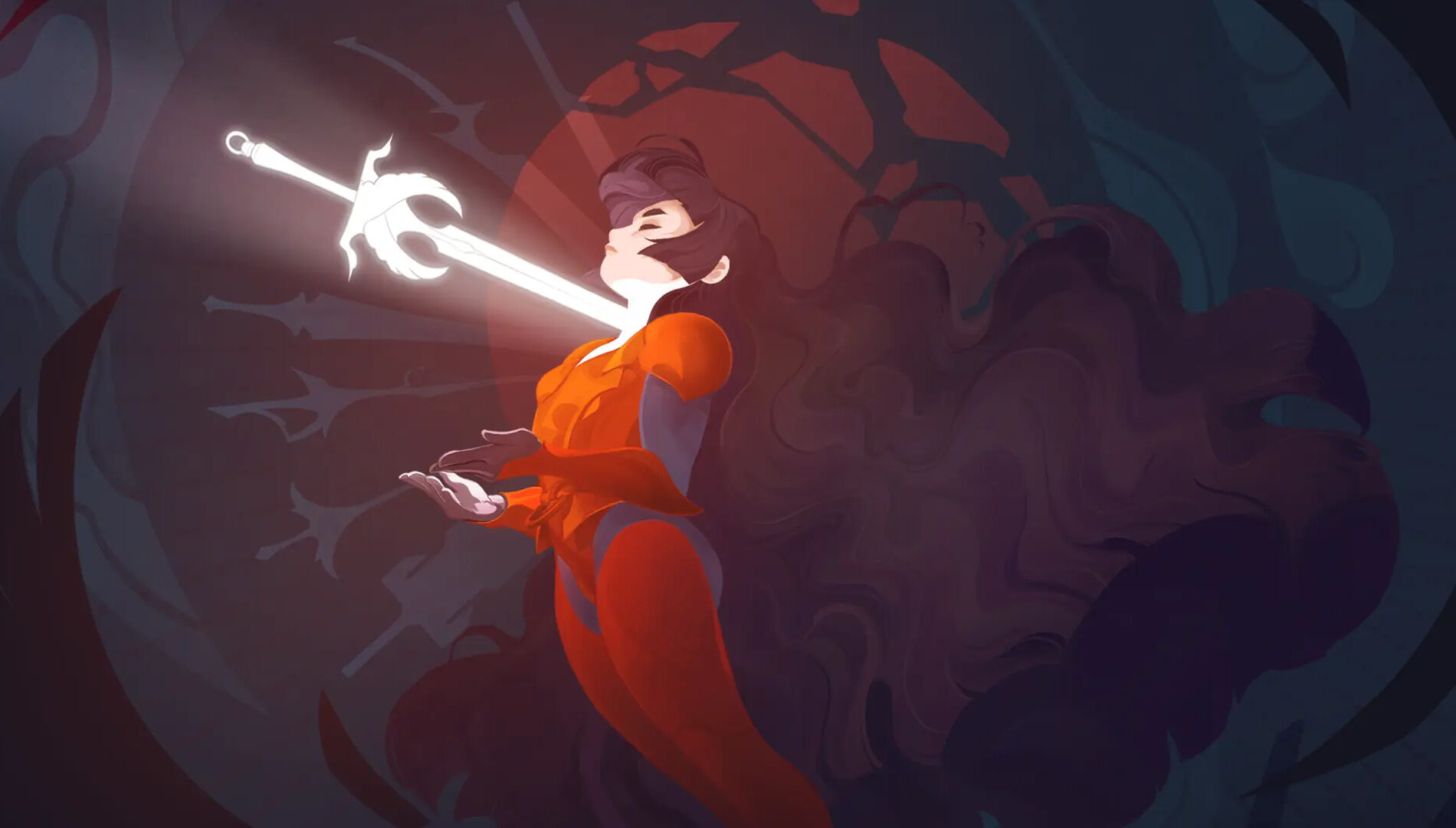
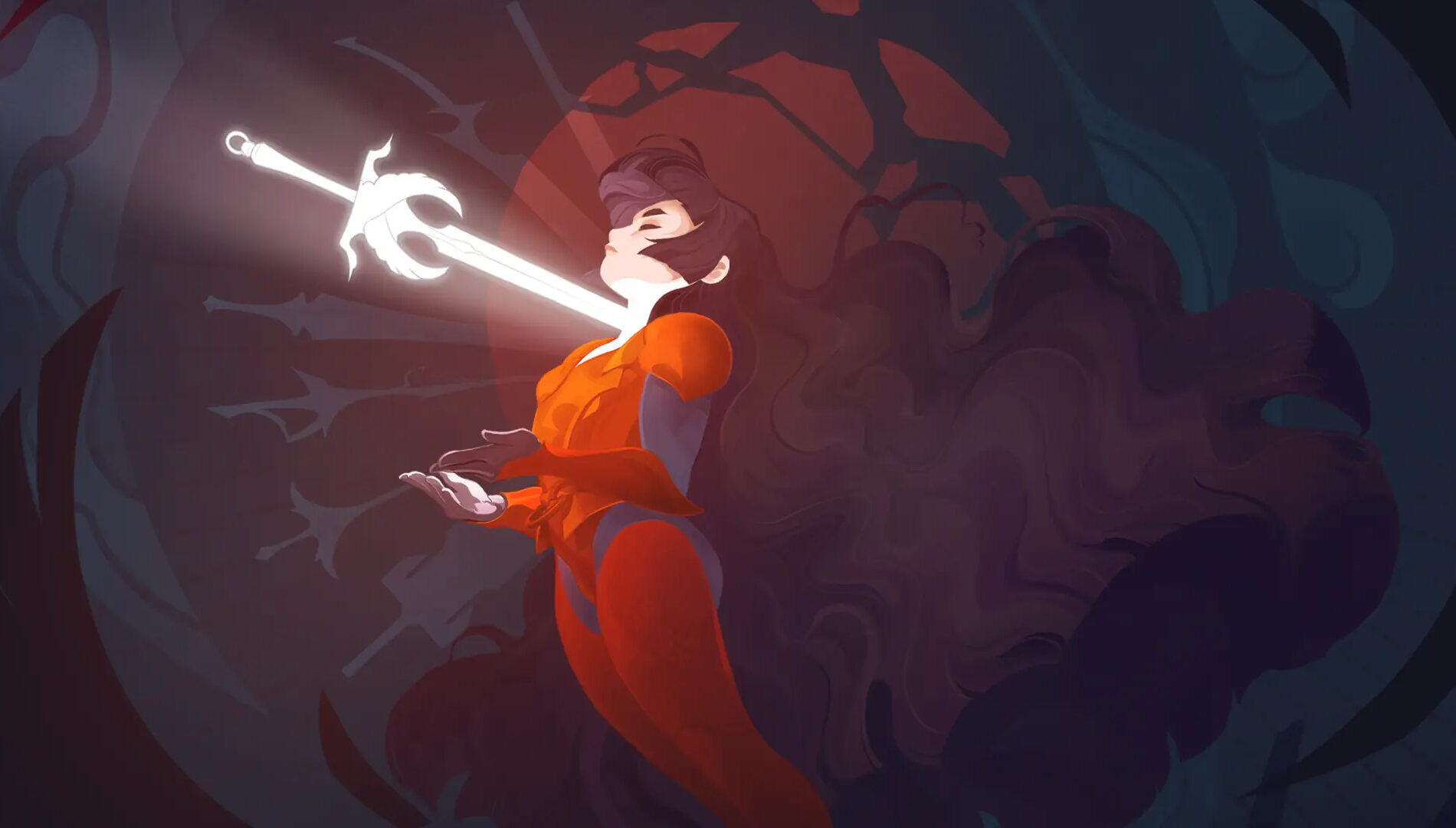
You play as Shan, youngest scion of the legendary Hemlock clan of knights, who telekinetically wields the God Sword Aesus, a glowing white blade that manifests out of her throat (more magical girl anime than body horror—she twirls around and her hair turns from black to white). Shan has just returned home from self-imposed exile to assume the mantle of Princess of Swords that her recently deceased mother had bestowed upon her. This will entail collecting the legendary blades of her older siblings, willing or not.
The first sibling you face is Camilla—tall, brash, eye-patched, and with an enormous mane of blonde hair—who meets you at the start of the game as you arrive home. She’s calls you “Muffin” and needles you about short you still are, and how you missed your mother’s funeral—classic sibling stuff. That layer of realistic character writing grounds and contrasts the mythic video game mode of the premise, and got me immediately invested in Shan’s journey. You’re not just defeating warriors to collect their magical swords—you’re reconciling with your famous family of talented, charming, and damaged siblings. It puts the literal royal back into “The Royal Tenenbaums.”
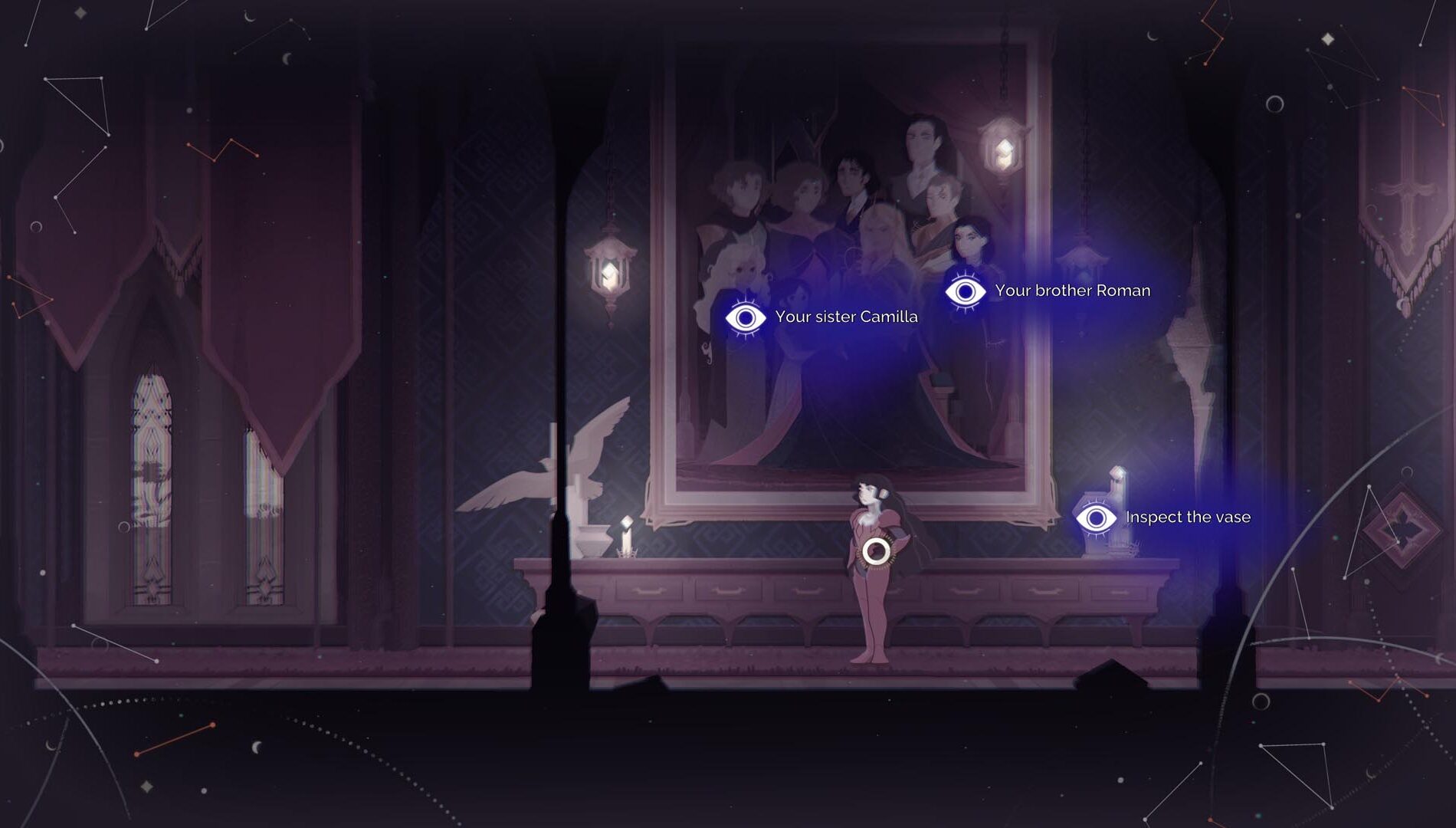
Camilla duels you as a combat tutorial upfront, but then leaves you to explore your family estate before you meet back up and fight for real. Combat, whether in major duels against your siblings or in regular fights against lesser monsters infesting your domain, is discrete and contained, marked by the aforementioned magical girl transformation to turn your hair white and draw your sword. The rest of the time in black-hair mode you run around, talk and observe.
I learned that Camilla, who had been in de facto control since your mother died as the eldest sibling, had not been a particularly present or empathetic ruler in Shan’s absence. As you observe the environment and talk to characters, you will sometimes collect cards of pertinent facts. In a menu with pages sorted by character, you slot these in to answer questions and develop your understanding of them. In this case, I learned about how Camilla had struggled under the burden of responsibility and retreated inward, leaving your domain in rough shape.
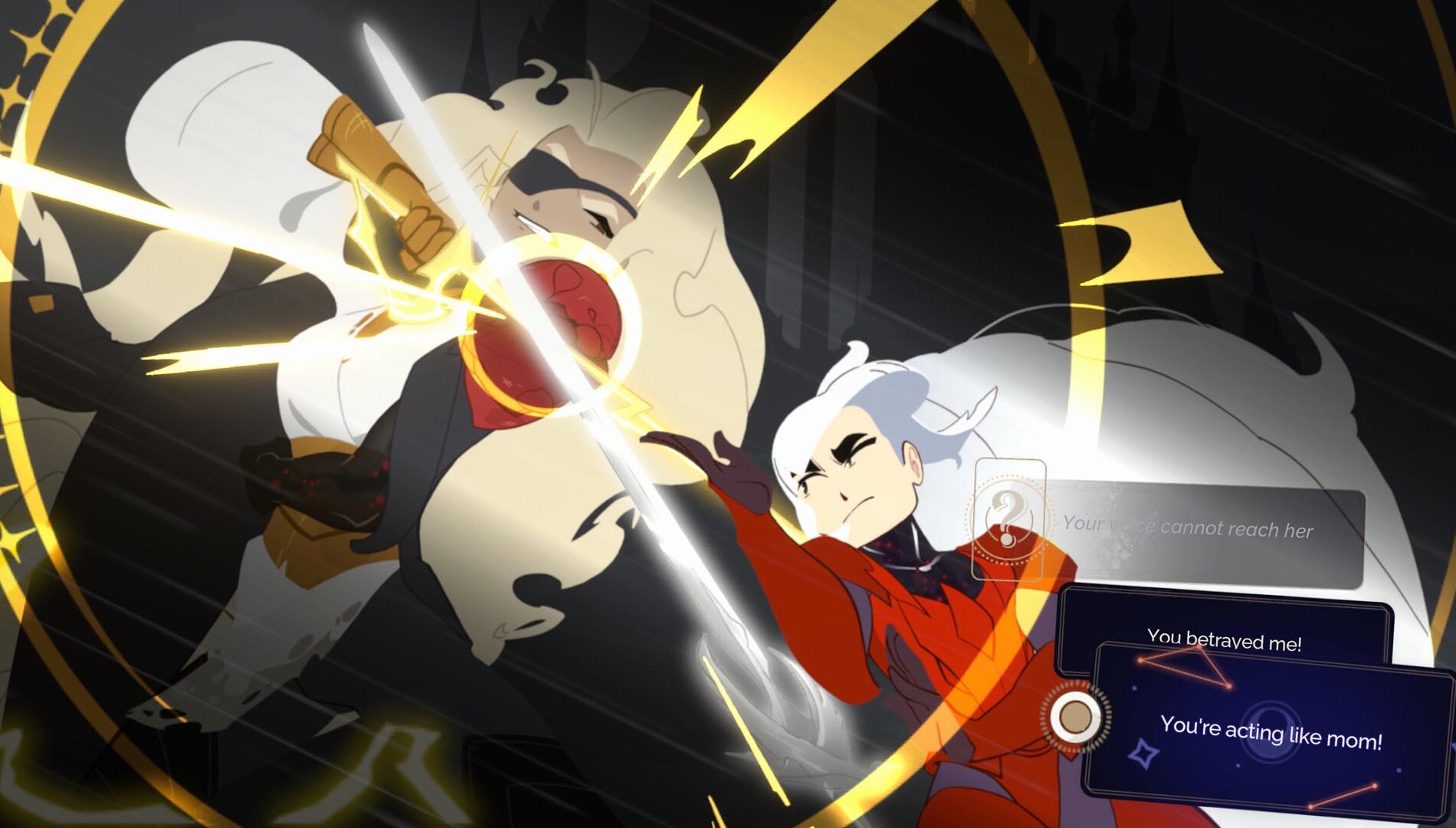
When I did finally duel Camilla for real, there were several dialogue breaks with choices between phases. Since the fight took me a couple tries, I made different choices to see the result, and found that when I made a more empathetic choice, Camilla lost a health bar, vs making a blunter dialogue choice led to me losing a health bar. It’s a cute way to mechanically reward your work in learning about the character and tie the combat in with the rest of the game’s narrative.
Combat was all about angles, as you attack in any direction around you as indicated by the right thumbstick. Enemies have shields with gaps (sometimes fixed, sometimes rotating), and a lot of the tactics revolved around when you could safely position to hit those openings. It was fun and strategic, without being too overwhelming. At any time, you can freeze the action with the right trigger to pause and assess, but also to use special abilities, such as a dash across the screen, or a ranged attack.
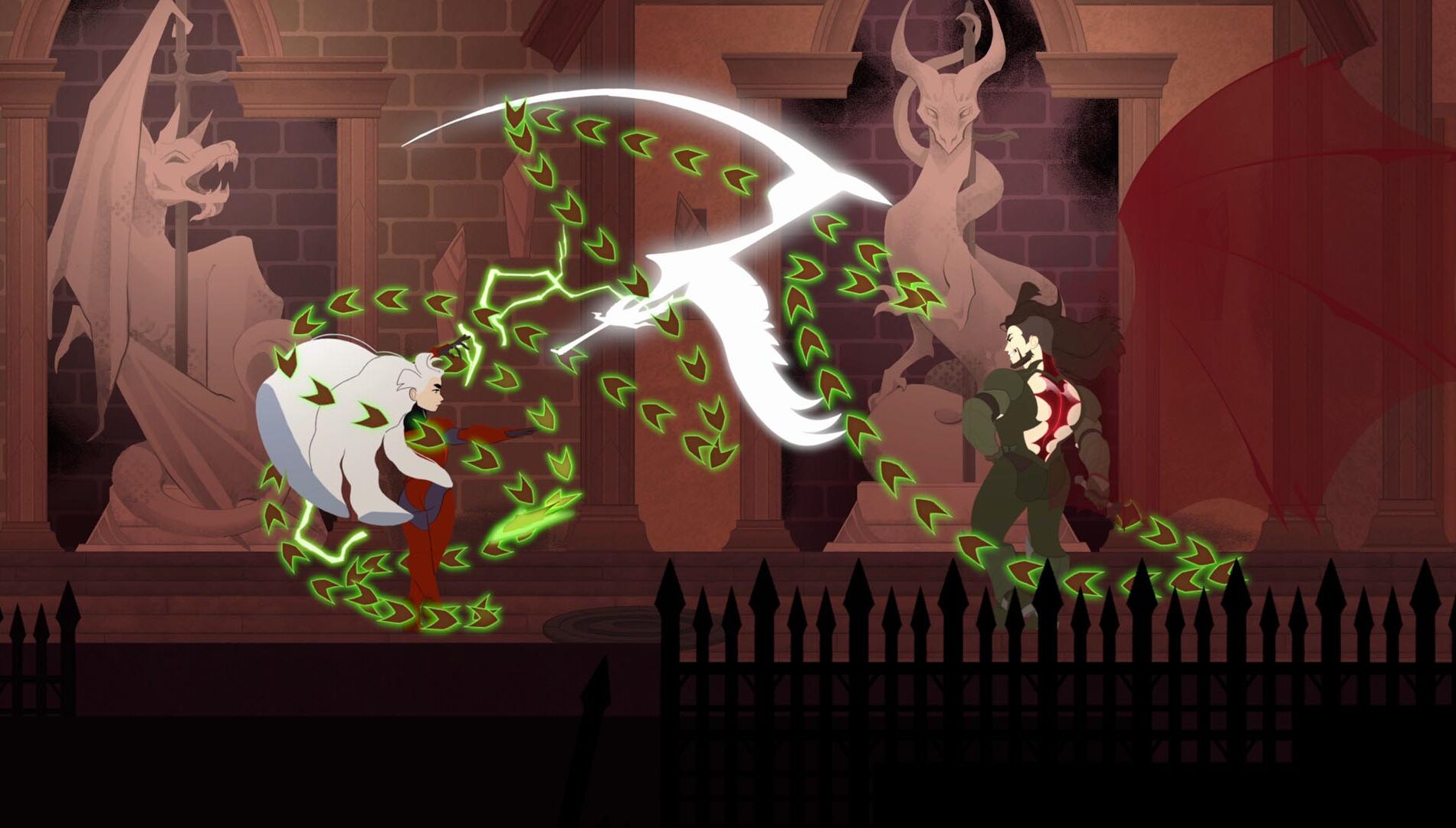
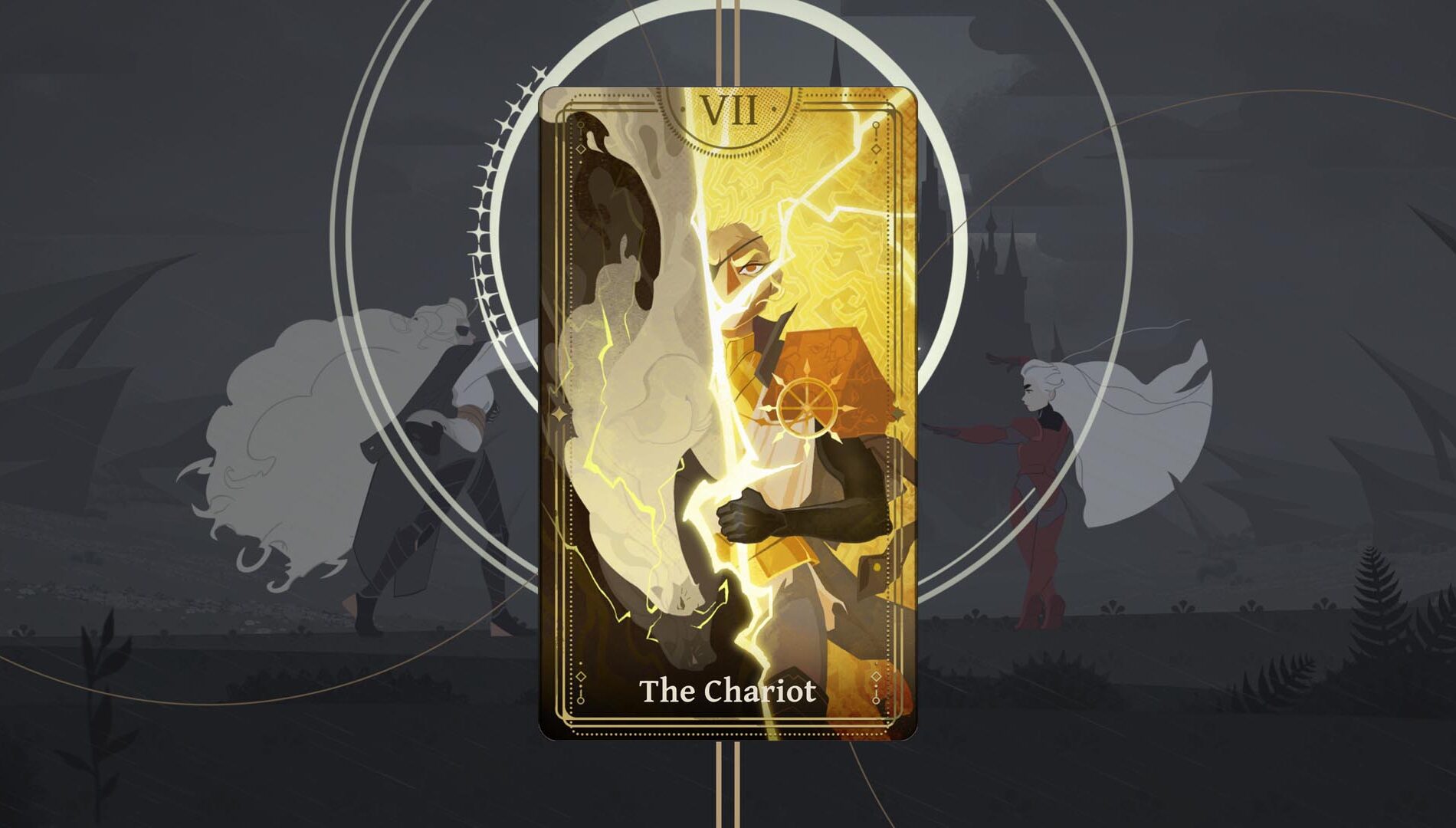
These abilities were tied to major arcana tarot cards associated with each of the two siblings I encountered—The Chariot for Camilla, and The Devil for Roman (a sly and sultry older brother that pulls a whip dramatically out of his spine, releasing demonic wings). In tarot a “reversal” is when a card is drawn upside-down, and read as a sort of inversion of its upright meaning. Each card could be used upright or reversed, with an alternate ability. The Chariot, which let me dash anywhere on the screen, reversed to Vehemence, which gave me a double-jump.
Tarot is thoughtfully suffused throughout At Fate’s End from top to bottom, connecting both the mechanical and narrative elements of the game. As a longtime casual practitioner, I am always a sucker for good use of tarot in games, and this already seems to be among the best, using the cards as both mechanical pieces and an additional layer of narrative and thematic color.
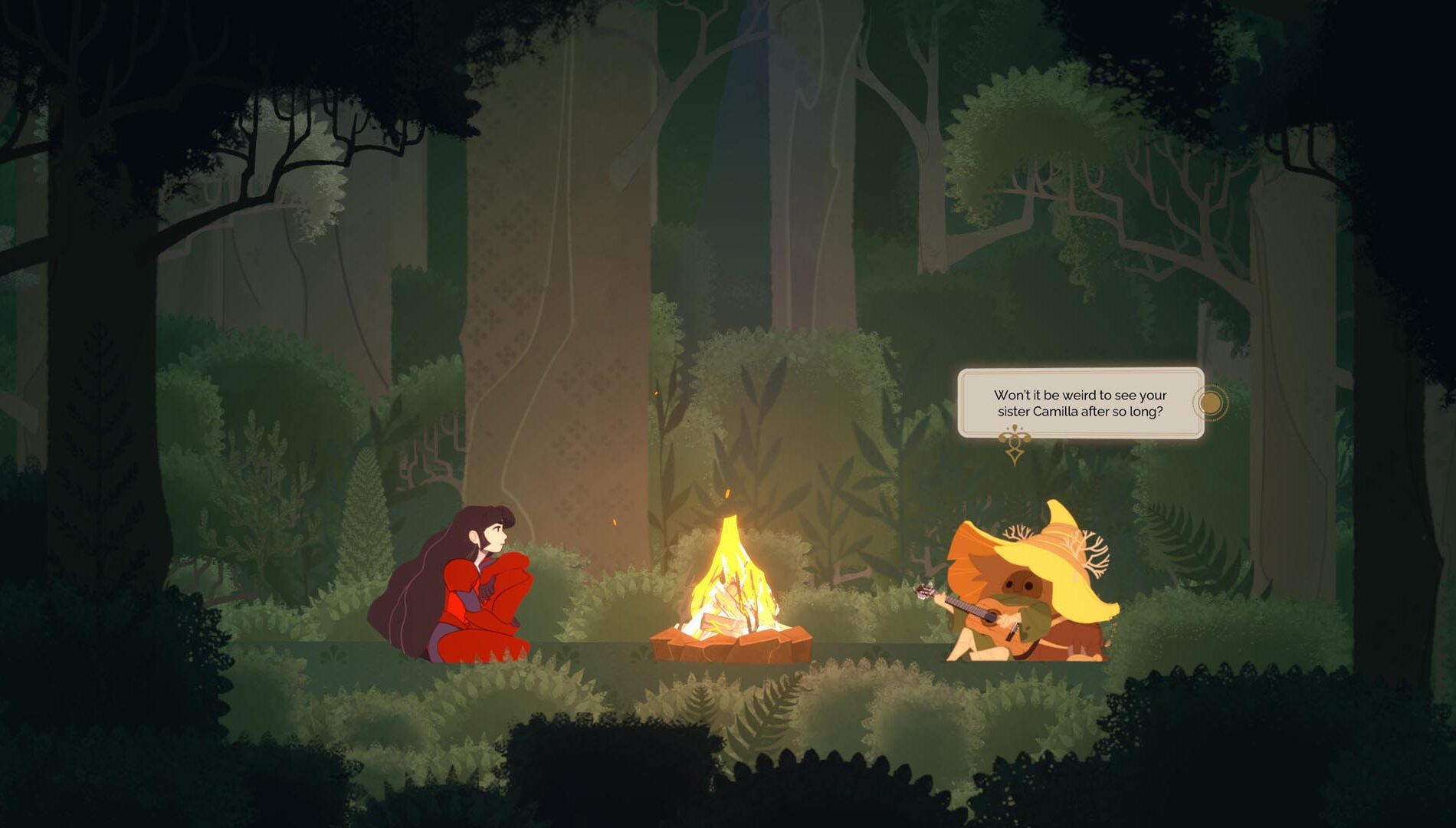
As mentioned above, the beautiful hand-drawn animation is the real special sauce that ties everything together. I don’t mind dying nearly as much when the way Shan picks herself up off the ground and furtively looks side to side is so cute. The character designs are iconic and charming (I can already see all the cosplay and thirsty fan art), and all of the classic fundamental principles of animation are on display.
Shan’s hair is a great example—it’s impossibly thick and flows down her whole back like a cape, and gives her such a distinct and dynamic silhouette. It whips around in dramatic secondary motion to emphasize everything she does, making her actions more powerful feeling and legible. There are no physically-simulated tresses here—just good old fashioned human artistry, and it made every frame of the demo a delight to take in.
I’m eager to learn more about Shan’s dysfunctional family and experience more of Thunder Lotus’ beautiful work when At Fate’s End launches later this year for Xbox on PC and Xbox Series X|S as an Xbox Play Anywhere title, and available day one with Xbox Game Pass Ultimate and PC Game Pass.
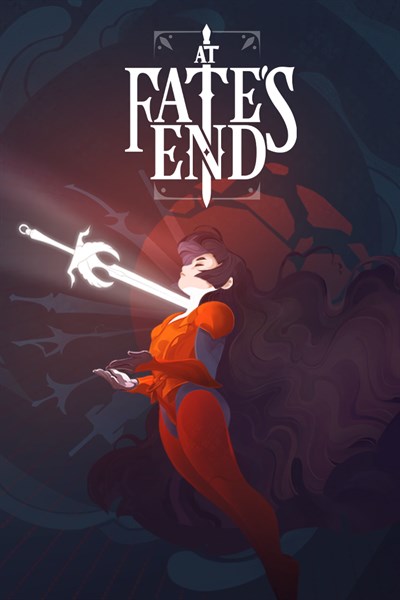

At Fate’s End
Thunder Lotus
Wield your blade. Confront your kin. Decide your fate.
At Fate’s End is an action-adventure game where you fight the ones you love. Wield the legendary God Sword Aesus as Shan, the deft young heiress of the Hemlock clan. Explore a lush, hand-crafted fantasy world. Defeat the foul creatures of the realm in combat. Solve intricate narrative puzzles, uncover painful truths, and hone both your blade skills and knowledge to face your estranged siblings in intense, emotional duels – and ultimately decide your family’s fate.
Battle with both swords and words.
Your blade may cut deep, but you journey will demand more than combat prowess. Shape confrontations through tactical dialogue and psychological insight, using your deep knowledge of your family’s secrets to gain the upper hand.
Your skill tree is your family tree.
Each sibling you defeat — or reconcile with — shapes your destiny. Collect seven swords of power to expand your arsenal of abilities and ultimately shape your family’s legacy.
From the Spiritfarer Team.
From the acclaimed team behind Spiritfarer, At Fate’s End weaves tight, visceral action with rich narrative depth, exploring the complicated bonds between brothers and sisters in a world where swords clash and family wounds run deep.
Fight with your sword. Speak with your soul. Face your family — at fate’s end.
The post At Fate’s End: Hands-On with Thunder Lotus’ Gorgeous New Action-Adventure appeared first on Xbox Wire.