




Eugene Jarvis hasn’t made a game in around a decade, and is enjoying a well-deserved retirement, but in the 1980s especially this guy made the most brilliant and brutally tough arcade games around. Defender, Robotron: 2084, NARC, Smash TV—all very different, all excellent, and every single one will kick your ass and gobble quarters like there’s no tomorrow.
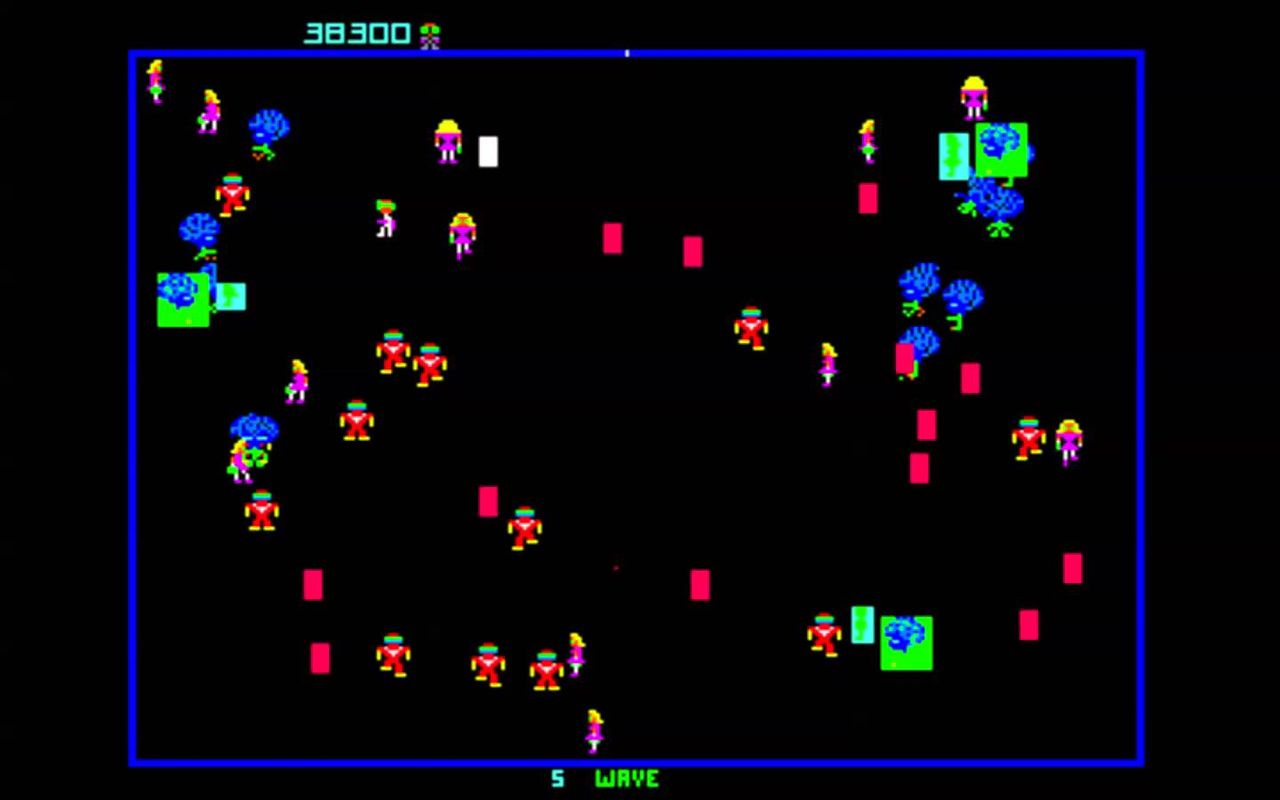
Even in this company, Robotron: 2084 is arguably the toughest challenge of all (and as with Defender was co-developed with Larry DeMar). Released in 1982, the game is a chaotic top-down twin stick shooter featuring 8-way movement and firing: You play as a genetically engineered mutant trying to save the last remnants of humanity from the robotrons, a human-created race of robots that turned around and wiped out most of the planet.
Each level starts with humans scattered around the arena, and dozens upon dozens of robotrons moving and shooting towards both the humans and yourself: any touch means death, for both yourself and the humans. It’s a game that forces you to keep moving and making split-second choices. It is impossible to save every human on every screen, so you’re constantly making the least-worst decision (at breakneck speed) while trying to stay alive.
Former Microsoft engineer Dave Plummer, best-known as the creator of Task Manager and 3D Pinball for Windows, recently trained an AI to master Dave Theurer’s 1981 classic Tempest. Tempest is an elegant game, but it’s also one that has many more of what Plummer calls “guardrails”—a single movement axis, much more predictable enemy behaviours, and far fewer decisions being made moment-to-moment.
In what is surely some act of coding karma, Plummer has now focused on training an AI to beat Robotron: 2084, which I’m not even sure is possible. But training an AI to take on a near-impossible challenge built around saving humanity from a robot uprising? The irony is off the charts.
“We’ve already taught one machine to dominate Tempest, which is a bit like teaching a robot to fence beautifully,” says Plummer. “Robotron is different. Robotron is teaching it to box its way out of a New Orleans riot.”
Plummer calls Robotron “a screaming 1982 arcade cabinet trying to murder you with a hundred simultaneous bad decisions at 60 frames a second [and] a brutally compressed lesson in real-time systems, human limits, and the difference between intelligence and reflex.”
Obviously an AI has many advantages over human players: it doesn’t panic, lose focus under intense pressure, and as Plummer says there’s “no adrenalin, no fatigue.” But Robotron is a unique challenge because it has that level of tactical decision-making over all the twitch skills: there is no way to play perfectly, or to avoid making decisions that will sometimes sacrifice humans.
“Robotron leans heavily on forcing humans to do dumb things in two dimensions,” said Eugene Jarvis in an email to Plummer about the project. “Running into a robot while trying to avoid a projectile. Chasing a human one inch too greedily. Flipping an electrode while dealing with a brain. It weaponises the fact that peoples’ resources are finite.”
“Robotron mastery is partly tactical, partly statistical, and partly an exercise in triage under uncertainty,” says Plummer. “The AI doesn’t merely need to dodge. It needs to understand what is worth dodging toward.
“The more I’ve dug into Robotron, the more I think it is one of the purest stress tests of real-time decision-making ever smuggled into a commercial entertainment product.”
Plummer’s video on the project is well worth a watch, not least for the obvious respect he holds for such a magnificent engineering achievement. Robotron may well be unfair but it is hypnotic and so well-made that playing it still ranks among gaming’s most intense experiences.
“Robotron is an old game, yes,” says Plummer. “A magnificent one. A loud one. A deeply unfair one. But it is also a laboratory. It is a place where 30 or 40-year-old design decisions about CPU cycles, linked lists, blitter modes, jump tables, and joystick ergonomics are suddenly back on the table because they still describe a live system with measurable behavior. And the moment you point an AI at it, the game starts revealing itself all over again. Not as a museum piece, but as an active adversary.”
Another fascinating element of the project is Plummer’s live training dashboard, which can be found here, and shows the AI playing Robotron, along with various graphs about how it’s doing in certain areas. It is weirdly compulsive viewing, and the project remains ongoing.