





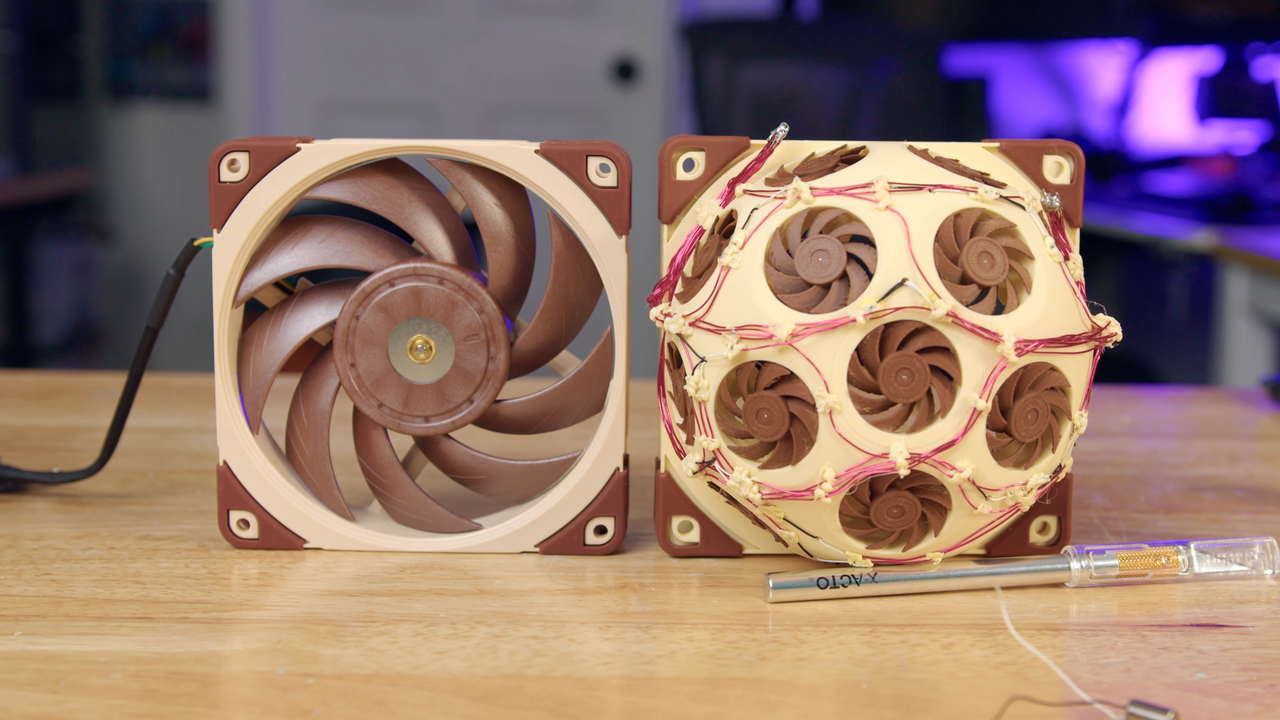
Have you ever thought, ‘There aren’t enough fans in my fan?’ That’s what I can only assume is the thought process of YouTuber Major Hardware, who has replaced one Noctua fan with 15 mini ones.
The inspiration for this project is a tiny ‘flying UFO’ toy that their kids were playing with. Major Hardware says, ” While watching it go around, I noticed that these little tiny fans do produce quite a bit of wind. They’re very loud, but… they produce quite a bit of air flow.”
Major Hardware found a similar 5V motor to the one in the UFO, bought a big pack of them to plug into a sequence of Noctua colored 30 mm fans, and found that 15 would offer a similar surface area to the 110 mm one they own.
From here, they used the base of the Noctua NF-A12x25 in a 3D model, and fit a plastic dome over the top to slot the fans in. They broke a motor mount in the first model, causing cracks due to a lack of an antivibration pad in the base. This is just a handful of problems that popped up in the first attempt. The joys of DIY.
The second model fixes those issues, and also routes the motor wires around the base, so as not to interrupt airflow. Major Hardware compares it to the Manhattan Project, but the top comment astutely re-names it “The Fanhattan Project”.
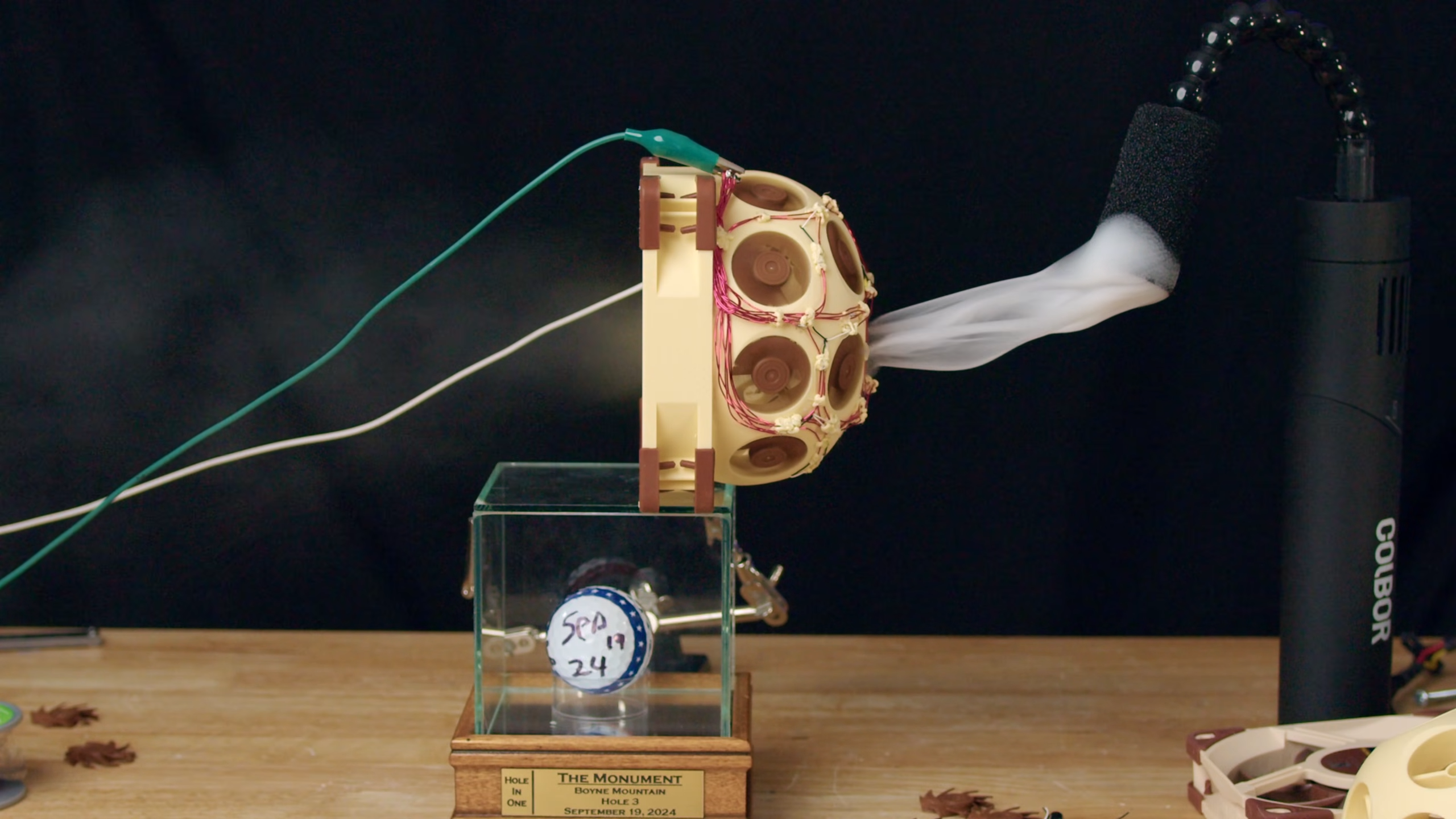
Major Hardware does try to make The Fanhattan Project close to Noctua’s in look, saying “this fan is basically a meme of the A12x25”. Once turned on, though, it really sings. Or, perhaps more accurately, screams. “It’s moving quite a bit more air than I expected. It sounds like a bunch of angry bees.”
If you’re wondering how loud exactly, Major Hardware’s fan registers 73 decibels, with nearly no peaks or troughs. That’s reasonably close to the sound of a dishwasher or vacuum cleaner. However, sound isn’t the only thing you’d test when setting up a fan.
In a testing suite, with an old Intel Core i7 7700K running for twenty minutes, the standard Noctua fan saw the CPU reach a temperature of 69.5 °C, where the Fanhattan Project got 69 ° C in the same tests. That’s technically better, but only fractionally so, and, as pointed out by Major Hardware, “pretty much within the margin of error”.
Still, if you can DIY your own biblically accurate Noctua fan and not get worse results, you’re winning in my book—just excuse all the noise.