



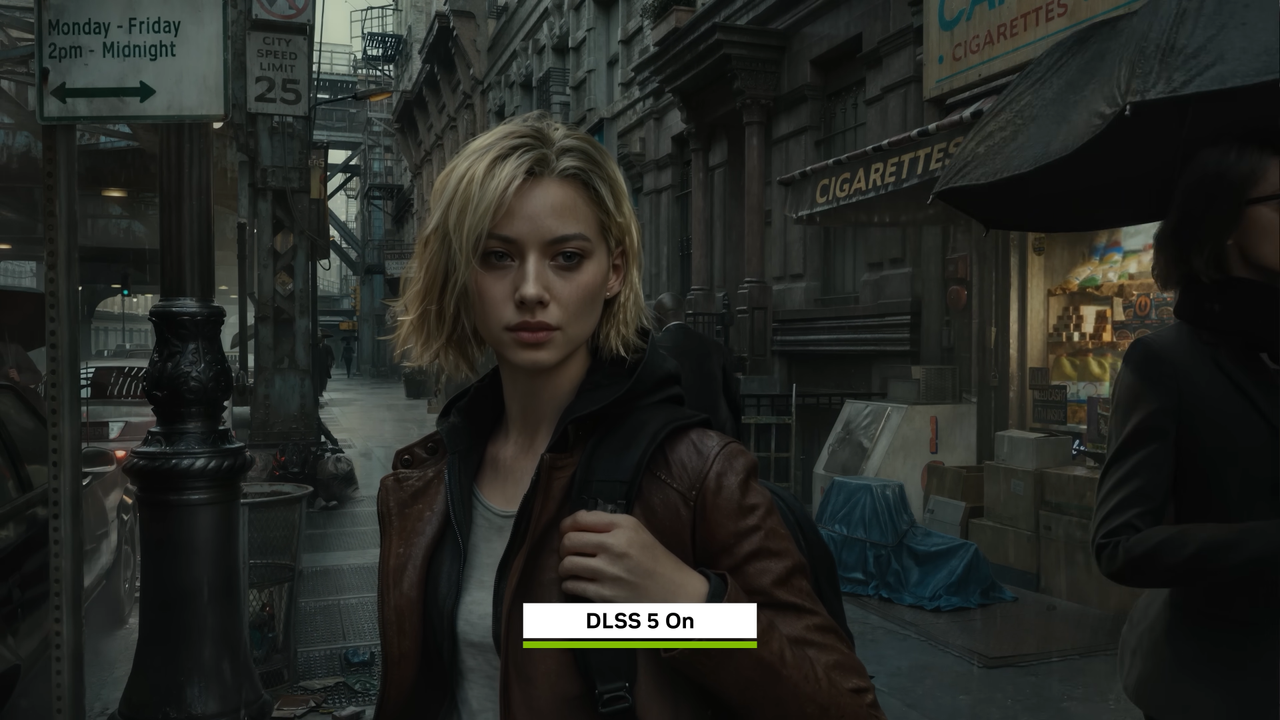
Nvidia’s DLSS 5 reveal has pulled in some very strong opinions. Since its unveiling, both Nvidia and Bethesda have clarified that developers will have creative freedom, but many developers have labelled it “slop” and “disrespectful to the intentional art direction of devs“. One particularly strong voice in favour of the tech is the lead producer of Epic Games, Jean Pierre Kellams.
As shared over on X, Kellams says, “All you guys roasting DLSS 5 like it doesn’t look better/is detracting from art direction are absolutely insane.”
“The lighting and shading improvements are bonkers. If that was shown as a next-gen hardware reveal and not “AI” you guys would be going nuts like the Watch Dogs demo.”
All you guys roasting DLSS 5 like it doesn’t look better/is detracting from art direction are absolutely insane. The lighting and shading improvements are bonkers. If that was shown as a next-gen hardware reveal and not “AI” you guys would be going nuts like the Watch Dogs…March 17, 2026
If you don’t know Kellams for his work on the likes of Fortnite, you may know him for his history with Platinum Games, working on the English adaptation of Bayonetta 2, The Wonderful 101, Devil May Cry, and more.
Ex-Intel alum and former owner of PC Perspective, Ryan Shrout, said that Kellam’s post “seems like the right answer to me”, and they went hands-on with the tech yesterday. They argue it’s “not a face filter” and “What I saw in the demos was a comprehensive improvement across the entire scene. And the moment that really drove this home wasn’t a face. It was a coffee maker.”
Shrout says, “One of the things I came away most encouraged by is the developer control story. This is critical. If DLSS 5 were a black box that slapped a one-size-fits-all enhancement over every game, the artistic intent concerns would be completely valid. But that’s not what this is.”
Interestingly, when a comment inevitably brings up the yassified Grace Ashcroft Nvidia showed off, Kellams argues, “Her skin shader has much better subsurface scattering (she doesn’t have the Japanese game character perfect skin). Her lips actually have creases now. Her ear stud is now catching light properly.”
Kellams finalizes his point, saying, “If I was a technical artist, I’d be begging for this right now. It’s essentially making super high resolution physically accurate lighting trivially cheap. If this is the demo, I can’t wait until tech artists start really digging in.”
Part of his argument is that DLSS 5 could be resource-efficient and that “the technical trade offs that you have to make for performance to get that level of lighting is untenable.”
Notably, this is something Nvidia noted with its RTX 50 series launch. In a demo, showing off neural materials, it managed to bring down memory usage on fabric by a third, which certainly does bolster this opinion. It claims “Neural Texture Compression leverages neural networks accessed through neural shaders to compress and decompress material textures more efficiently than traditional methods.”
I disagree… Look at Grace’s face. Her skin shader has much better subsurface scattering (she doesn’t have the Japanese game character perfect skin). Her lips actually have creases now. Her ear stud is now catching light properly. The light source from the right side of the…March 17, 2026
Notably, when discussing artistic intent, Kellams argues that you can’t guess at intent until a director comes out and states as such, and that some of the tone or atmosphere from games are purely tradeoffs made for certain engines or models. He claims Nvidia’s Resident Evil Requiem demo “has WAY WAY WAY better lighting” and a more realistic world.
“The gloominess you became accustomed to is actually a feature of lighting tradeoffs that DLSS 5 is ‘fixing'”, Kellams states.
Though the demo Shrout and the likes of Digital Foundry got access to was seen running through two RTX 5090s, it’s worth noting that it will be at max 4K settings for demonstration purposes, and Nvidia has said the tech will be usable on a single GPU when it launches later this year. We’ll have to get hands-on to find out the performance hit you will get in return for DLSS 5.
But wide adoption of DLSS 5 will largely be about how consumers react to it, and Kellams thinks that ship has already sailed. “I get that some very vocal people don’t like AI. But guess what. Technology doesn’t care if you like it. It is a tool. AI isn’t coming. It is here. Just this morning my oncologist was telling me all the ways it is helping cancer treatment and research.”