
Retro Games…we love them, but we have missed so many. By just playing our favorites, there are countless other gems that never managed to grab our eyes. In this exclusive Old School Gamer Magazine post, author Patrick Hickey Jr. gives us five retro games we need to find and play.
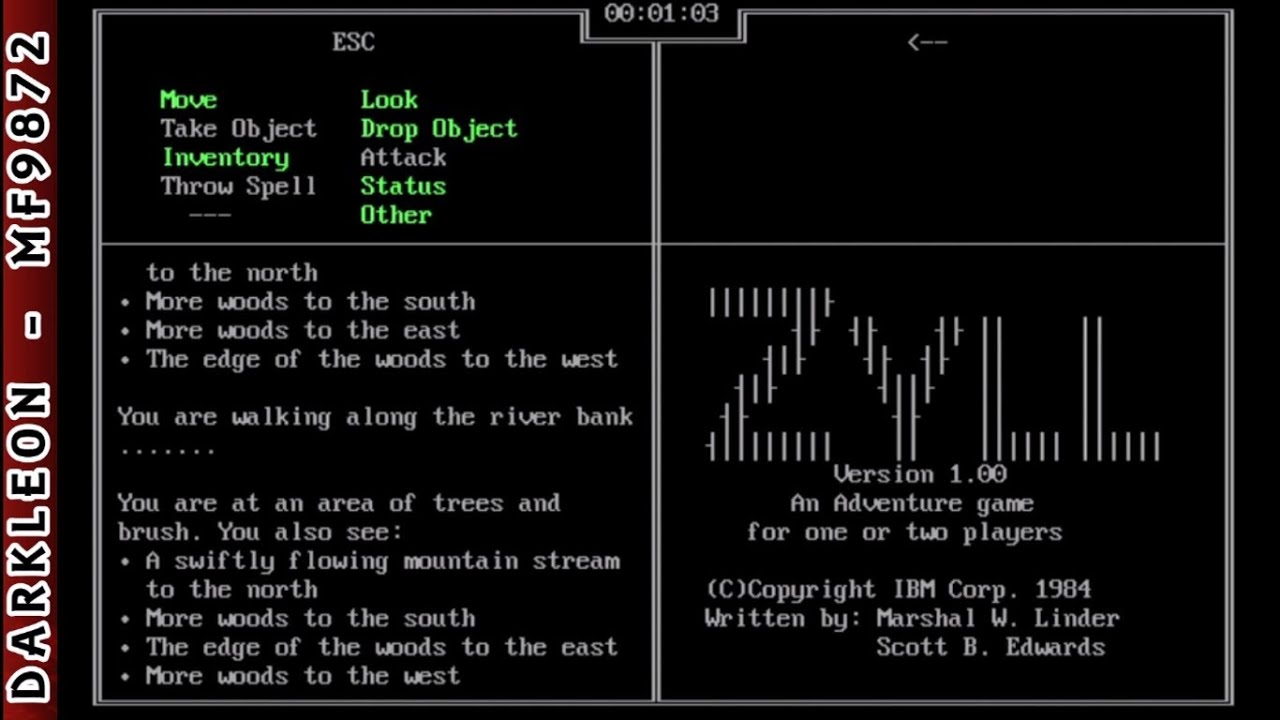
Zyll (IBM): A single or two-player cooperative or competitive, non-linear adventure game with role-playing elements, customization options and real-time dungeon exploration and combat, Zyll sounds like a game you’d want to play right now, right? Before you get too excited though, understand that Zyll was released 35 years ago and is largely text-based. But even so, with its arcane visuals by today’s standards, Zyll remains an influential computer game because of the sheer innovation that made it completely ahead of its time.
Zyll’s ability to draw multiple players into the experience was just as influential, years before the technology of network gaming was available. Truth be told, Zyll is probably the first ever couch-co-op PC game. Making players share a keyboard while playing, it foreshadowed the machine’s ability to be more than an educational device. Following the game industry crash of 1983, Zyll proved that even though home consoles couldn’t be financially successful enough to stay in stores, game developers could continue their work in other ways and advance the art form. Years before games the likes of Wizardry, Ultima and Wasteland made the computer role-playing genre a household name, Zyll was one of the early, inspirational titles that proved the imagination and hunger for games had just begun.
Hunter: The Reckoning (Xbox and Gamecube)
Games that blend gameplay genres can be tricky ones for consumers to grasp, but the ones that do it well are remembered forever. Although not a monumental seller, clocking just over 480K units in its release on the Xbox and Gamecube in 2002, High Voltage Software’s Hunter: The Reckoning blended the Hack-and-Slash, Beat-Em-Up and RPG genres seamlessly together, all the while creating an experience that played the best with four players. Certainly different from other titles released at the time, especially considering the rise of online gaming at the time, Hunter the Reckoning is a couch-co-op cult classic and a throwback title that any fan of games such as Gauntlet and Loaded will instantly be attracted to.
Although the game features an original story, Hunter: The Reckoning is loosely-based off the popular White Wolf tabletop RPGs of the same time and is set in their World of Darkness universe. The game’s story begins after the execution of convicted serial killer Nathaniel Arkady at Ashcroft Penitentiary. Of course, this is anything but a “normal” death by electrocution. As Arkady’s life fades to black, four bystanders, Spencer “Deuce” Wyatt, Samantha Alexander, Kassandra Cheyung and Father Esteban Cortez witness the souls of the prison’s damned escape in an attempt to exact revenge against the prison’s Warden. The quartet then received a spiritual calling to stop the attack and protect the Asylum’s residents. That gives the heroes the courage and power to stop the onslaught and put an end to the supernatural uprising. Eventually, the prison is abandoned, but on the anniversary of the closing, teenagers (of course) decide to have a party on penitentiary grounds, causing the evil to return. With most of the teenagers dead and the town now in danger, Wyatt, Alexander, Cheyung and Cortez return to save the day once again.
While the story sounds cool, the gameplay elements encompassed within Hunter: The Reckoning compliment it perfectly. All four of our heroes play different from one another and all have their own unique “edge” maneuvers that help clear the hordes of the damned off the screen forever. As a result, you’ll have to think and not just run into enemies. Perhaps taking a page from the tabletop RPG world White Wolf was thriving in at the time, the upgradable weapons and stats in Hunter: The Reckoning add another layer of depth to the experience. Because of that, the game ends up conforming to the experience the player wants and can be markedly different depending on who’s controlling what character.
Buck Rogers: Countdown to Doomsday (Sega Genesis): Sometimes, a game is just a game- and a port is just that, a port. Although video games are often seen as art, they are also a way that people earn a living. Sometimes, there’s no magic at play. Sometimes it’s a job. Although a game beloved in cult circles for its connection to the Dungeons and Dragons ruleset, nifty box art and its importance as an early PC to Sega Genesis port, Buck Rogers: Countdown to Doomsday, developed by Strategic Simulations and published by Electronic Arts, is essentially a game that was watered-down immensely for its console release. While many gamers on Sega’s 16-bit console had no experience with the other feature-laden versions and appreciated the sci-fi story and fun on the Genesis, the what-ifs around the game’s development leave questions as to how much more a legacy the game could have had if a few things went in other directions during the development cycle.
For the Genesis port’s lead programmer, Michael McNally, who would later go on to work as a Director of Software Engineering, in charge of Ad Traffic and Publisher quality at Google and a Director of Engineering at Facebook, his work on the game was important to him for a variety of reasons but was never as creative as it could have been. Nevertheless, that never stopped him from trying to make the best game he could.
“I came on late to Buck Rogers and was the sole developer porting it to the Sega Genesis. It was also my very first and my only, console game,” McNally said. “Since the game had to be massively modified to fit on a very different device, I took liberties to improve it at my sole discretion. If I recall correctly, this was somewhat scandalous and exasperating to project management (who usually kept developers on a tight leash) and my fellow engineers greeted by modifications (which I would surprise people with as completely coded) with some humor and glee.”
Haunting: Starring Polterguy (Sega Genesis): Electronic Arts are known for their massive collection of Sports titles and a growing catalog of first-person shooters, but once upon a time, they actually had a team of developers put together for the sake of being creative. Known collectively as the Electronic Arts Creative Development Group, this team put together one of the most innovative and unique games of the Sega Genesis library- Haunting: Starring Polterguy. While the game was never a massive hit, its fun gameplay and the cool isometric camera made it a cog in many video rental stores during the early ‘90s.
Controlling the Polterguy, it’s the player’s objective to use over 400 items around four different homes to scare the Sardini family outside. Designed by the legendary team of Jon Salwitz and Dave Ralston, known for their work on such iconic arcade romps as Paperboy, Cyberball and Rampart, Haunting: Starring Polterguy represents a time in EA history where they were willing to take a chance on something different. The man they put in charge of this production, Don Traeger, made a name for himself being a part of both unique and successful titles. In addition to being the man that helped build the EA Sports dynasty, he was also someone who had achieved a level of success at the Atari Coin-Op Division, a part of the company that continued to pump out quality games in the arcade well after the North American video game crash of 1983. If anyone knew what was cool and what gamers could get into, it was Traeger.
“Polterguy was a pretty big departure and that happened because of all the success we were having,” Traeger said of the rise of Electronic Arts at the time. “Electronic Arts wanted me to start a new group that was all internal developers but doing more risky stuff. So we called it a Creative Development. We went over to our own space, we had our own lab. There were a lot of my friends from the arcade days- engineers that I’d worked with. And our charter was just kind of creating and designing projects that were new ideas. We didn’t want to get caught in the sequel stuff. One of the early ones that came out of our creative development group was a game called Sketchin’ that was rollerbladers, grabbing onto cars and racing. So we developed that one a bit and sent the initial design to CSI, which became EA Canada.”
Powerslave (PlayStation): First-person shooters were all the rage in the ‘90s, mainly because they were different. They weren’t arcade shooters, light-gun shooters, or platformers, genres that had all been done to death by that time. Thanks to games the likes of Doom and Wolfenstein 3D, there was a ton of developers that saw the genre an opportunity to jump on the bandwagon of success. While there were a plethora of weak copycat FPS games out there (Even cereal companies the likes of Capt’n Crunch designed their own FPS games to try and cash in.), Lobotomy Software’s Powerslave was a unique, fast-paced shooter with a cool storyline that is undeniably different from the ton of other FPS available at the same time. Although there was never a sequel in the series and low-sales (thanks to poor marketing and a limited number of copies available) on the PlayStation hindered its legacy, it remains anything but a Doom clone. Add in a design team that consisted of Ezra Dreisbach (Champions of Norrath), Dominick Meissner (Days Gone and Assassin’s Creed: Rebellion) and Brian McNeely (Quake and Duke Nukem 3D) and it’s easy to see how influential the game is to the genre.
Thanks mainly to its sense of speed, a banging score, cool assortment of weapons and abilities, sometimes brutal difficulty and fun story, Powerslave felt different from other games in the genre, but had enough already cemented FPS sensibilities to be recognizable to those already addicted to the style of gameplay. Fighting off aliens and mummies in the Egyptian city of Karnak, you’ll have to jump, swim and run through caves and temples. And do it all through narration by legendary voice actor Don LaFontaine. With items to collect through the gun-slinging journey and a pair of endings, Powerslave was an under-appreciated title that proved more could be done within the constraints of the first-person view. It’s safe to say that, in its own way, Powerslave laid the groundwork for games such as Fallout 3 and Metroid Prime.
The post Five Retro Games No One Played But Should Have appeared first on Old School Gamer Magazine.