

I love a supercomputer reveal, and this one’s a little different than most. China’s National Supercomputing Center in Shenzhen has announced its LineShine system, a machine that aims to deliver 2 exaflops of performance once it’s fully constructed.
That’s an impressive figure, and would make LineShine one of the fastest exascale supercomputers in the world (via HPCWire). This one, though, is planned to be an all-CPU system—in contrast to virtually all of the others on the Top500 list, which make use of AMD or Nvidia GPUs to accelerate proceedings.
This will be a supercomputer of sheer processor-induced heft, and some of the stats are jaw-dropping. The first construction phase will link 100 Huawei Kunpeng servers together, with 12,800 cores spread between them. The second phase, according to reports, will involve the addition of an extra 47,000 individual CPUs spread across 92 compute cabinets.
A pre-print of a paper entitled “Breaking the Training Barrier of Billion-Parameter Universal Machine Learning Interatomic Potentials” gives us some more potential specs of China’s new toy. The paper says that the total system will be made of 20,480 computing nodes, each equipped with two Armv9-based LX2 processors.
Each of those LX2 CPUs has two compute dies with 304 cores in total, which run alongside eight 32 GB HBM stacks. Every node is linked by a “LingQi high-speed network with dual-plane multi-rail fat-tree topology, offering 1.6 Tb/s bandwidth per node.”
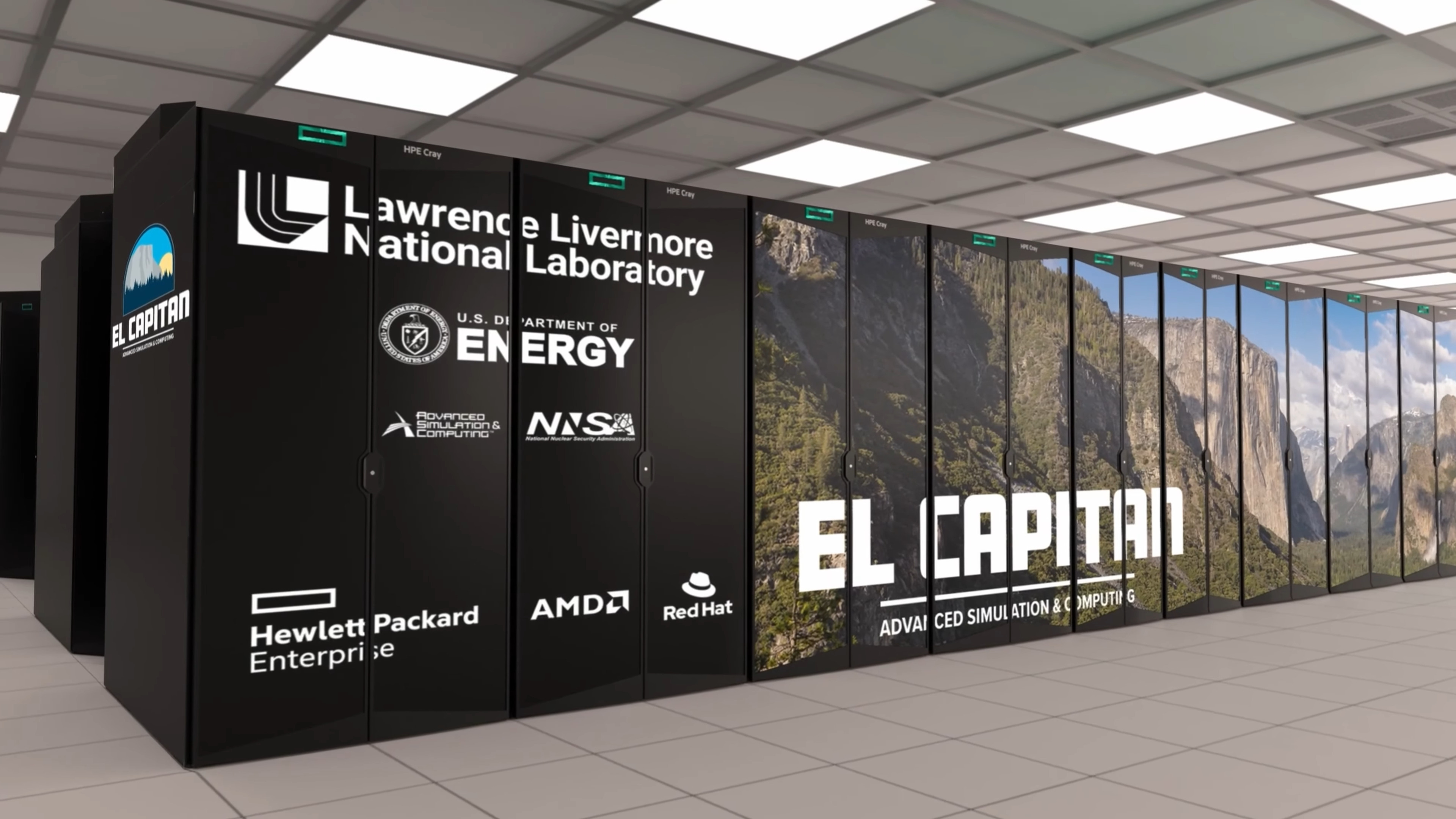
I know what at least some of those terms mean. Anyway, if these specs and performance figures are accurate, the LineShine would take its place as the fastest all-CPU-powered supercomputer ever built—although El Capitan currently holds the record for the fastest overall in the Top500 listings, with a 2.74+ exaflop Rpeak result.
As for its purpose? Apparently, it will deliver “internationally leading performance in large-scale applications such as molecular dynamics, fluid simulation, life sciences, and AI large-scale model training and promotion.” Y’know, supercomputer stuff. A bit boring, isn’t it? Imagine the Geekbench score, folks. Surely it’s worth a run just for giggles?