
At this year’s Computex event, Nvidia announced something that many PC enthusiasts have been waiting for. No, not its Arm-powered RTX Spark laptop chip, but a forthcoming update for DLSS Ray Reconstruction, one that brings it on par with the rest of the DLSS 4.5 package.
Back in January, Nvidia launched DLSS 4.5, with a significantly upgraded Super Resolution (upscaling) algorithm that uses a transformer model instead of a convolutional neural network to improve visual fidelity at the expense of some performance. At the same time, Dynamic Multi Frame Generation (DMFG) was also announced, but that took a while to finally arrive.
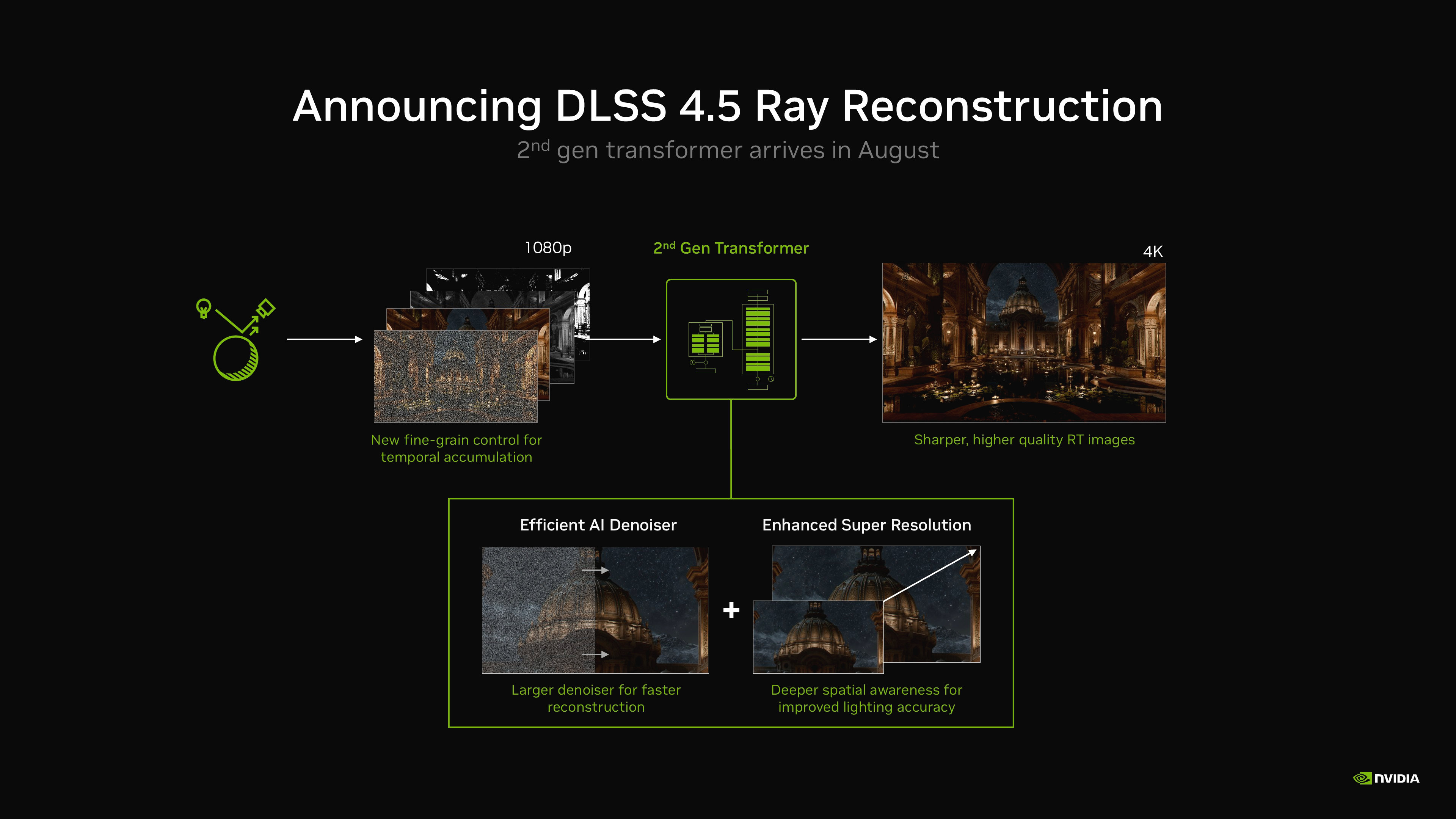
However, one upgrade was noticeable by its absence, and that was anything new on the Ray Reconstruction (RR) front. This is Nvidia’s AI-powered ray tracing denoiser, a system that tidies up ray-traced scenes, but what makes it somewhat unique is that it also runs DLSS Super Resolution at the same time.
As things currently stand, you have one of two choices when playing ray-traced games with DLSS: You can either have DLSS 4.5 transformer upscaling or DLSS Ray Reconstruction; you can’t have both. What that means is that you have no way of enjoying the benefits of the newer upscaler, because RR uses an older one that employs a convolutional neural network.
In August, that will no longer be the case, because DLSS 4.5 Ray Reconstruction will make an official appearance in at least 27 games, including Cyberpunk 2077 (naturally), Doom: The Dark Ages, Alan Wake 2, Pragmata, Resident Evil Requiem, Indiana Jones and the Great Circle, Hogwarts Legacy, and Crimson Desert.
This second-generation RR algorithm not only employs a transformer model for its upscaling stage, but the AI denoiser also leverages a larger training dataset, processing 20% more parameters, to give “improved lighting accuracy, better temporal stability, and clearer motion in ray-traced and path-traced content”.
While it’ll be great to finally have a denoiser+upscaler that’s as good as the rest of the DLSS 4.5 suite, Nvidia has certainly taken a long time to bring it out. Admittedly, it’s not like we’re utterly swamped with ray-traced games that fully support DLSS, but I think I would have preferred to have seen it before DMFG.
Radeon GPU owners will probably know that AMD also has an AI denoiser, as part of its FSR Redstone project, but so far, there’s been no word on when we’re going to see that being used in more than just the one game that it’s currently employed in (Black Ops 7).