
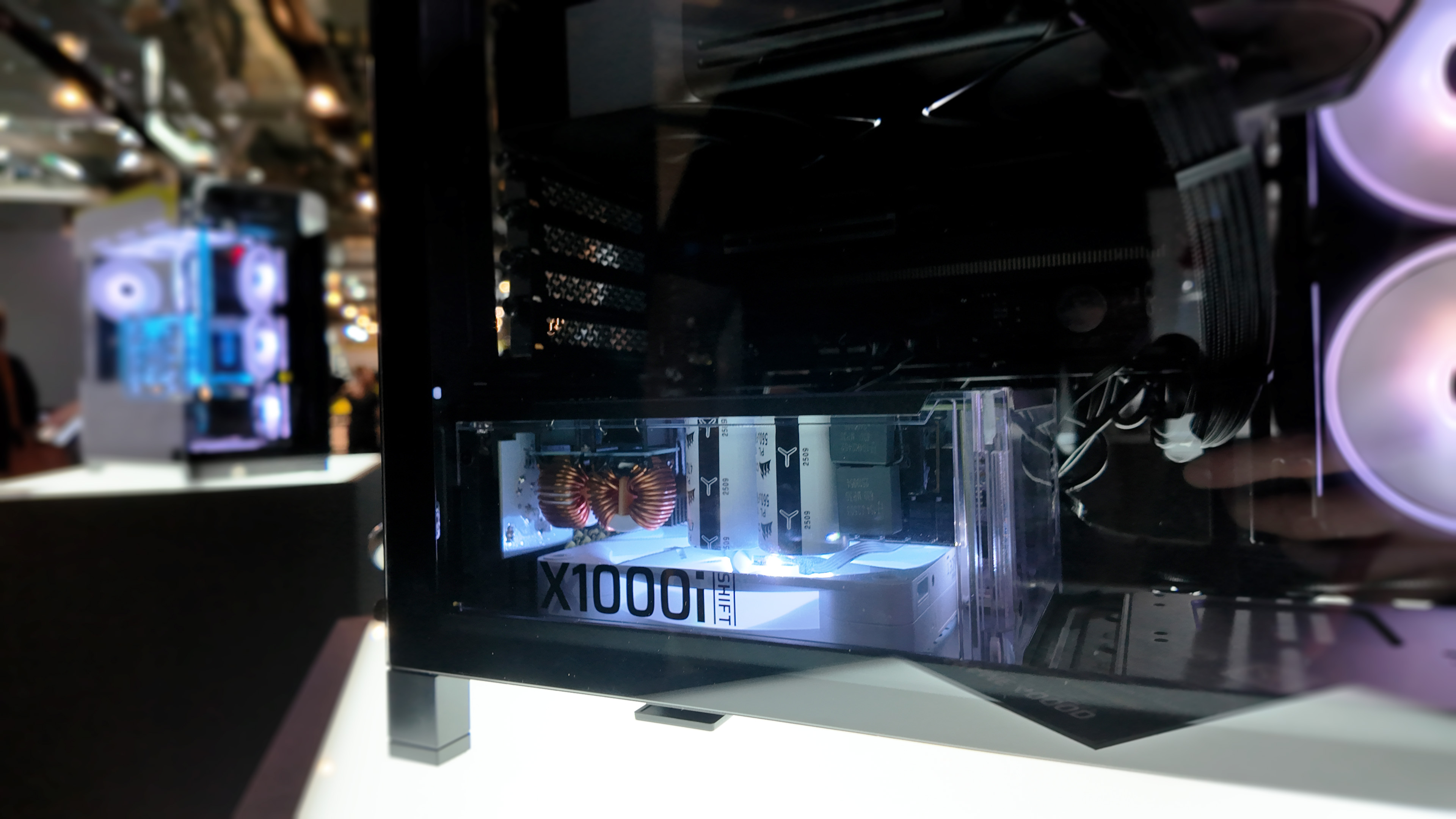
The games industry has been putting transparent glass and plastic on its hardware for decades now, yet Corsair’s see-through power supply might feel a tad too vulnerable for my liking. Luckily, Corsair has also shown off a case that seems hardy enough to protect it.
We have seen Corsair’s HX1000i Shift Crystal before (its 1000W transparent power supply) before but the reappearance of this tech at this year’s Computex is a good sign that it’s no longer just a prototype. It now has some official specs on the Corsair website, and all.
Speaking of specs, it’s a platinum-certified ATX PSU with a RGB 140 mm fan, a ten-year warranty, and it has custom-made capacitors. On the capacitors, Corsair says, “If you’re going to showcase the internal components of your PSU, they should not only look good enough to attract attention but also be built to a high standard to complement the impressive aesthetics.”
Given it’s a Shift power supply, it has power connectors on the side, as opposed to the back, which gives easier access in compatible cases. It’s a pretty neat function that should help your cables look equally neat.
Corsair has also announced the Warthog PC case, which is a military-themed case that’s supposed to take after the Vengeance C70 the company launched back in 2012. It’s a mid-tower case which can accommodate a 430 mm GPU (without front fan in), 200 mm PSU, 3 x 120 mm front, side and top fans, as well as 1 x 120 mm fan in the rear and bottom.
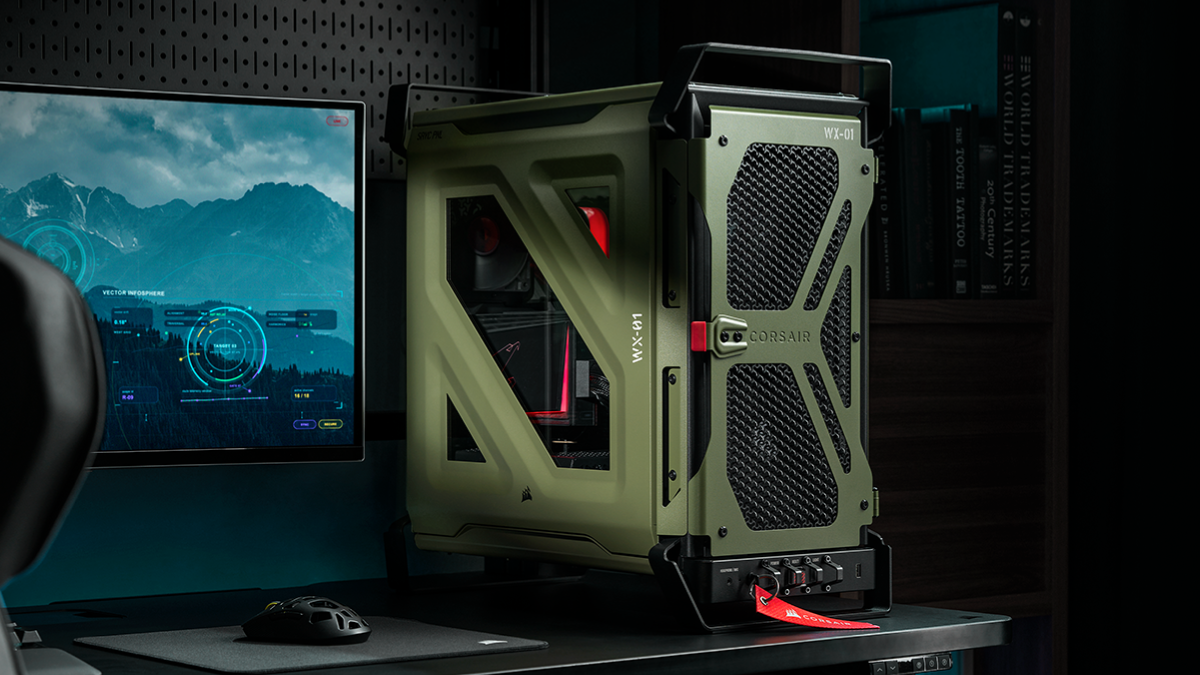
It might be because it’s called Warthog, but the Olive Drab really reminds me of the Warthog from Halo, and I think that makes me like its chunky military look a little more. It has fighter jet controls on the front to turn the PC on, and built-in handles to pick it up. It’s an easy thing to say about a military-inspired PC case, but it’s a bit over the top.
At Computex today, Corsair has also shown off the iCUE Link Titan II 360 RX RGB cooler, iCUE Link Titan II 360 RX LCD cooler, 2800X RS-ARGB case, and has taken its wooden Frame 5000D case to the floor too. Still, none of it is quite as striking as getting to literally see the capacitors in your power supply, even if that’s a bit more intimate than I wanted to get with such zappy components.