
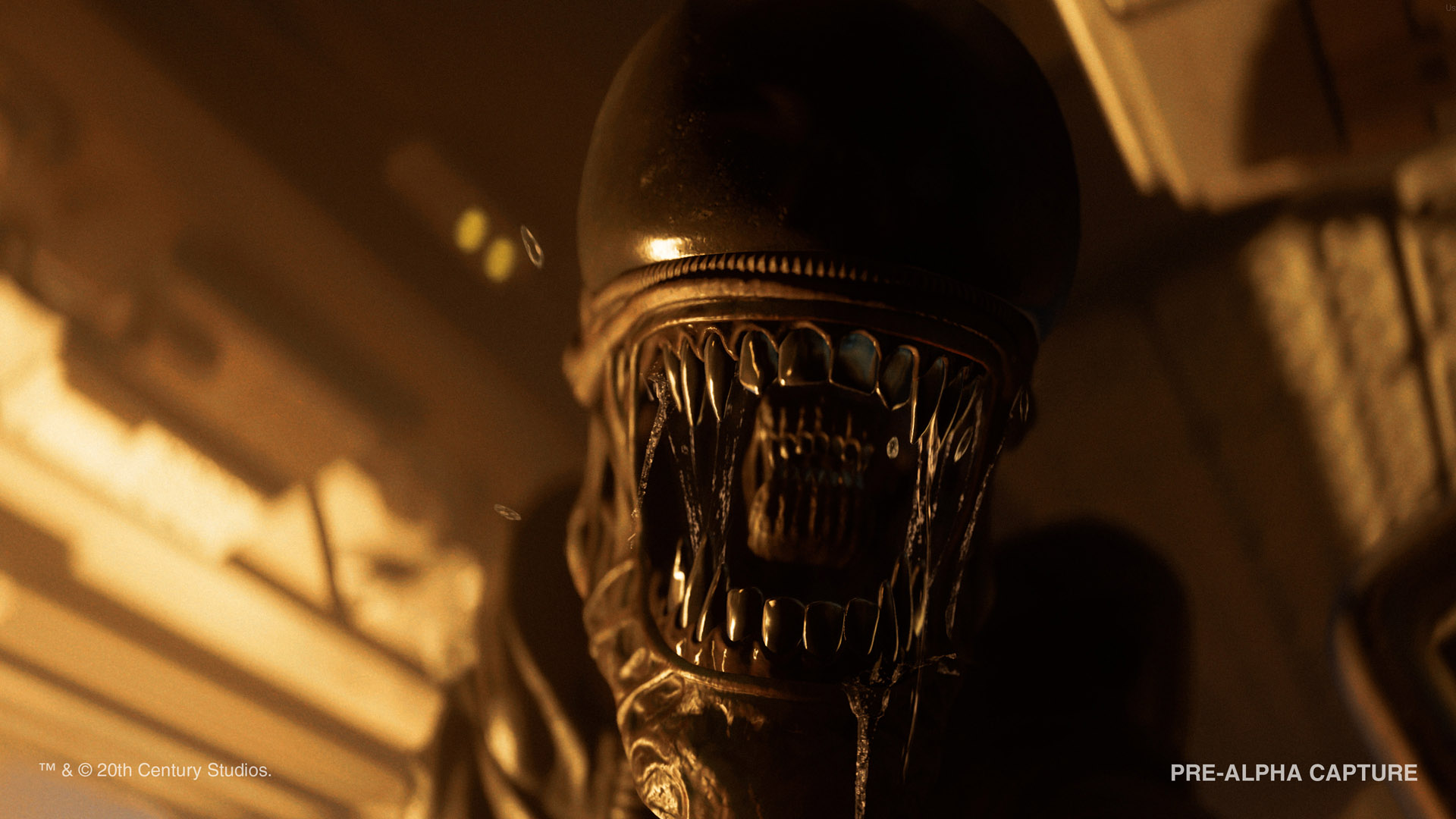
Alien: Isolation 2 is Poised to Deliver Another Bold Chapter in Survival Horror
Summary
- We played the Alien: Isolation 2 prologue at Summer Game Fest: Play Days and lived to talk about it with the creative geniuses at Creative Assembly.
- Creative Director Al Hope, Art Director Ana Sopikova, and Lead Game Designer James Green provide insight into their craft behind this highly anticipated sequel.
- Alien: Isolation 2 is available to wishlist now for XBOX Series X|S on the XBOX Store.
I was determined to wait it out. I could see the terrifying Xenomorph through the window, pacing up and down the corridor, trying to suss out my location – meanwhile I was holding my breath under a table in the adjacent room, trying to remain out of sight. The ladder to escape was right there in the hallway, just out of reach… next to the alien. Each time I built up the courage to move out from under the table, the alien seemingly sensed it and came into the room. Back under the table I went. We must have done this dance for five minutes or so, but it felt like hours.
If there was ever a doubt at Creative Assembly’s genius being able to make that magic strike twice, those fears (small as they were) have been put to rest after our brief 20-minute hands-on gameplay session of Alien: Isolation 2’s prologue at Summer Game Fest: Play Days this past weekend.
“When we think about the sequel, we wanted to expand and evolve beyond what we did in the first game,” explains Creative Director Al Hope. “Coming out of the tin-can-in-space experience into a new world, onto our planet’s surface, and really opening the canvas and telling a new story – which is still really closely connected to the first game. Having this new outpost, Kurosaki Station, that we could bring to life, which would have those claustrophobic interiors where the player feels trapped – and is super familiar to anyone who’s played the first game – but now also allows us to have these hostile exteriors that you’re going to be hunted in.”
The events of Alien: Isolation 2 take place months after the events of the first game, featuring a new protagonist, Blake, a Weyland-Yutani employee. As the hands-on demo kicks off, we’re along for the ride on a survey expedition when a tremendous explosion occurs outside. The team then steps out of their large transport to investigate the crashed craft that has plunged into the planet’s surface… but from where?
Walking outside for the first part of the demo gives us a tease of the terror that CA is going to be playing with for Alien: Isolation 2. While a fierce storm is pelting us from overhead, drowning us in rain, I navigate through twisted roots and wet mud that feels like an intentional callback to moving through the alien hive’s slime-encrusted interiors of Sebastopol Station from the first game. The tension is thick, magnified by the deep brass horns and crackling thunder – audio design is making its place known once again as a key player in an Isolation experience.
“Audio is half the experience,” adds Hope. “It’s such a massive component of any horror experience, but for us, it’s enormous. It’s kind of our shortcut to helping steer how you’re feeling and thinking; a shortcut to your brain. One of the other ways we think about the Isolation experience is like an information war – what do I know versus what the enemy knows? And then you have all these modifiers that play with that to either enhance it or take it away. And weather is this great disruptor for all those bits of information. We’ve got so many ways we can have weather influence the experience. It really kind of gives us, a really definitive way of expanding the core Isolation experience.”
Coming back to my demo, I continue to investigate the outside of this crashed ship and eventually find a hatch that can lead us inside, to much protest of Blake’s companions. “But we need to check for survivors,” she says. Entering the detached lab gives us a break from the storm, but we know something isn’t quite right in here.
This inside harkens back to the retro-futurism that we’ve come to know and love from the Alien franchise, with analog monitors, unreliable fluorescent lighting, flips and switches along the walls, and dark, rubber hoses strewn about that make me second guess what I’m actually looking at.
“I really love the idea that players, when they’re in the interior, are feeling really trapped and claustrophobic and they want to get out just like before,” Hope says. “But after that initial rush of, I’m no longer trapped, they start to feel exposed and vulnerable. Riding this sea of emotion and motivation felt like such a delicious mix – that was something that seemed like a really, really great opportunity for a sequel.”
“It really allows us also to stick to the original pillar of Ridley Scott’s 1979 ‘Alien,’ because we are still very much laser-focused on that part of the franchise,” adds Art Director Ana Sopikova. “You still have those claustrophobic spaces, and it’s still very much the lo-fi sci-fi clunky, chunky tech that is not going to save you. Everything is very analog. And then you just add in that flavor of exteriors, it’s a different type of fear, right? You’re confined, and then you’re exposed. It’s still as desperate as ever.”
As I proceed deeper into the seemingly abandoned craft, I collect computer components that have been strewn about, plugging them into control panels along the wall to help restore lighting and power to the facility. Continuing to navigate the interior, I make my way to a nearby lab to access additional computer terminals to continue to bring systems online and learn more about the crashed ship – and that’s when the big reveal hits: this is a hazmat lab that has broken off from Sebastopol Station. And just to compound that revelation, the Xenomorph drops from the ceiling, making its grand entrance. Time to hide.
This is where my learned experience from the first game kicks in immediately. I duck under the nearest table and listen as the alien moves about the room looking for any hint to uncover who was the source for all the racket. Eventually it moves off and I duck into a nearby floor vent shaft to try and backtrack my way out of the lab.
“It’s interesting seeing different players approach that differently and spot different things,” explains Lead Game Designer James Green. “Things that would be obvious to one player don’t occur to other players. It’s really important we have that in the prologue because that’s kind of the model for all the other encounters. I think the phrase we like to use is: more player agency, more player choice, more small victories. Even if you’re only moving 10, 15 feet, but that feels to you like the biggest thing you’ve ever accomplished in a game. Those little moments are really important, and we wanted more of those, and different ones for different players.”
“But it’s still all about diverting and trying – it’s not about overpowering, not about killing the alien. That’s not what we’re all about. It’s just giving you tools to distract and escape. That’s the focus,” adds Sopikova.
This feeds into something that I wanted to talk to the team about, is how they strike that balance to create a layer of fear so it remains exhausting (in a good way) without falling into frustration – as I was playing, I felt myself already trying to build up the courage and acceptance that I will fail. Eventually, the alien will get ahold of me – but that’s part of the fun… right?
“The way we think about it is tension and release,” explains Hope. “We could probably change the settings so it’s just unrelenting and completely menacing, but I don’t think that would be a very satisfying experience for most people. It’s about getting that balance right – that it feels tough but fair. It needs to be true to the movie, that idea of people trying to survive and improvising to survive. It’s not a power fantasy; it’s about trying to understand and make the right choice at the right time. It might not be the best choice, but it might just be enough to enable you to move on.”
To Hope’s point, the save stations are the most obvious example of this – where you punch your card in, bank your progress, and breathe a sigh of relief. That small victory over the Xenomorph. And then you go again, taking that next step into a darkened corridor. “We’re trying to create this survival playground with these systemic elements. We start you in one point and ask you to get to another point, and what happens in between is really down to you, the systems, and the choices you make,” adds Hope.
“I think one thing that having lots of options gives you is, if you’re facing a challenge – which is what happens in the game; you face these huge challenges – we know that if the game is too frustrating, that starts to push against the fear a little bit. You start to see it as a game,” explains Green. “But the different options mean you have this moment where you say, ‘Oh man, this is really hard. It keeps getting me; it keeps anticipating what I’m doing. Maybe there’s something else I can try. I can try a different kind of tactic.’ That means it’s going to play out differently. And we want to make sure that when you do that, it does play out differently, and you go, ‘Oh, okay, I get it.’ But then, in the next encounter, something different will happen. The alien will do something different. You will do something different.”
Preserving what was great about the first game feels like a monumental task, one that CA is poised for by understanding how to retain that core Isolation experience that many of us are already familiar with – improvise to survive, the menacing alien, the relatively simple goal of trying to escape and survive – but with that attention to detail: the immersion, the audio, the vision breaks, the lighting, all coming together to deliver something that feels truly authentic.
“I think that’s what we see as the heart of the experience, with our player choice within all those systems,” says Hope. “And I guess for us, for the sequel, it felt like the opportunity was, okay, well, let’s take that and let’s evolve it in interesting ways. Taking the experience both interior and exterior, having this creature now be able to learn and adapt in both of those spaces, felt like a really natural evolution. And yeah, the opportunity to tell a new story and kind of shine the spotlight on a new part of the world.”
Back to my hiding place, I’m continuing to try and wait the alien out. It doesn’t want to budge – then suddenly, it goes up into the airshaft. The way is clear; I make my move. I get into the hallway, and I see the ladder just ahead to escape the lab – and I can hear the alien is closing in behind me. As soon as my hand grabs the ladder, it grabs me and is moments away from plunging its slimy teeth into my skull that an explosion rocks the lab, sending both of us spiraling, marking the end of the demo.
I could feel the adrenaline still pumping through me as I stood up from the gaming station, turned around, and found that most of the Creative Assembly development team had been standing behind my chair, watching me play those last five minutes. “We were all rooting for you!”
I think it’s fair to say that we’re all rooting for them as well. This is a sequel I think few thought would ever come to light. But now, having played it, the excitement is palpable and contagious. Alien: Isolation 2 is real – and it’s going to scare the hell out of us. I can’t wait.
Alien: Isolation 2 is available to wishlist now for XBOX Series X|S on the XBOX Store.
Alien: Isolation 2
SEGA
So begins a desperate journey to survive and escape, as she is relentlessly hunted by the deadly creature.
The post Alien: Isolation 2 is Poised to Deliver Another Bold Chapter in Survival Horror appeared first on XBOX Wire.