
It’s probably fair to say that Unreal Engine is probably the most comprehensive tool around for creating games, animations, and video effects. And, with the launch of UE 5.8, it’s becoming even more extensive and even a little bit more AI-friendly. Whether you’re just an Unreal Engine hobbyist like me, or a full-time game developer, you can download version 5.8 right now via the Epic Games Launcher.
Even if you don’t plan on using any of the new features (of which there are a lot), it’s always worth trying out the latest release just for bug and performance fixes. But what’s actually new? The headline acts in UE5.8 are the introduction of Mesh Terrain and Procedural Vegetation Editor (PVE). Both are experimental features at the moment, but the former should be of great interest to anyone creating big, open-world terrains, as the tool basically generates full 3D meshes for you.
PVE is somewhat similar, except that instead of creating landscapes, it produces vegetation (trees, bushes, reeds, grass, etc) from scratch, with the procedural system working in line with meshes already present in the world. For example, let’s say you had a crumbled old archway in a forest, PVE will ‘grow’ trees around it, accounting for the natural source of light and competing vegetation.
Complementing these are MegaLights, which first appeared in experimental form in UE5.5 (but is now “production-ready”), an experimental fog screen space scattering feature, and perhaps most interesting of all, Lumen Lite. This is a mode for Lumen global illumination that Epic claims to be twice as fast as Lumen High Quality, while still preserving “much of the visual impact”.
The release notes for UE5.8 specifically mention that “games that rely on global illumination for artistic purposes can run on Nintendo Switch 2 at 60 fps,” so it’s blatantly obvious what platform it was developed for. However, since it’s also supported on PC, UE-powered games of the future could well offer this as a graphics option for low-end hardware users.

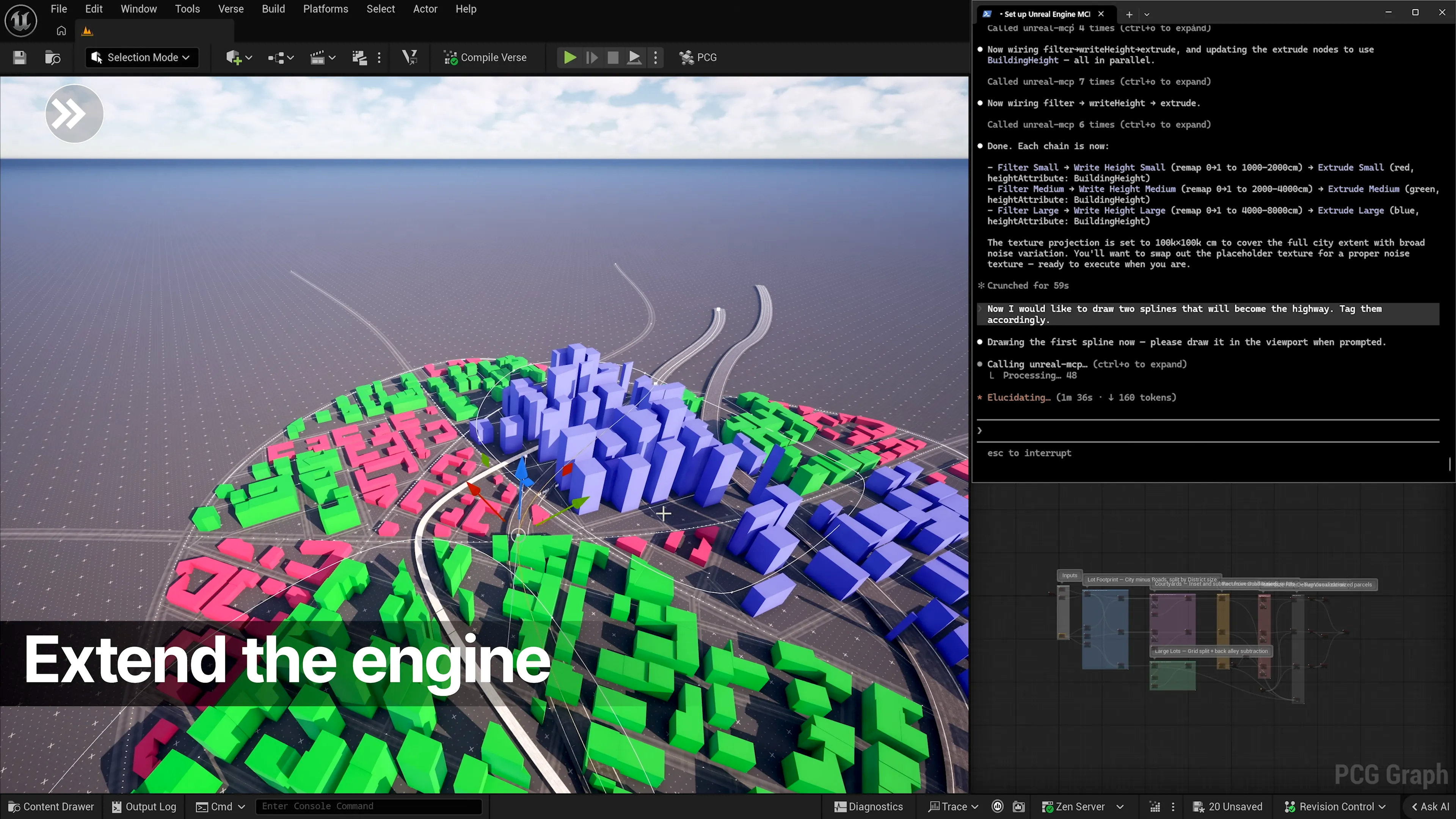
Tucked away, almost at the end of the new version details announcement—which blessedly includes improvements to shader compiling—is one more experimental feature, an MCP plugin. With this, you can implement any LLM of your choice to “connect to and understand both the engine and your project.” In other words, if you want to use AI to create assets or code, carry out tests or refactoring tasks, then you should be able to hand that over to the LLM easily enough.
Epic left the note about this feature after everything else, and I suspect that’s because AI is hardly flavour of the month in the world of PCs and gaming right now. After all, Epic already has a section of PC gaming fandom that takes a dim view of Unreal Engine games, whether you believe that’s the fault of Epic or a given game’s developers themselves, and AI-use is another PC gaming bug bear.
Anyway, because of the consternation about AI in gaming—from being the primary cause of the horrendous price increases for DRAM and SSDs, as well as the endless controversies over its use in games—the inclusion of this plugin is likely to draw ire from some quarters.
The thing is, many game studios will have to rely increasingly more on AI for certain workloads if they hope to stay afloat. With the likes of Microsoft and numerous other companies about to swing a sword of Damocles across all their gaming divisions, studio heads will be looking at every avenue that will result in them having a future.
I’m not suggesting that game devs must use AI, nor am I saying that the inclusion of the LLM plugin (specifically an MCP server) with UE5.8 is a good or bad thing; it’s simply a sign of our times. One can argue that Unreal Engine’s feature set is sometimes a little too far-forward in reach (console and mainstream PC hardware still isn’t quite good enough to cope with an all-in Lumen and Nanite game at high fps), but this minor plugin is very much a ‘here-and-now’ thing.