
Since large-language models like ChatGPT can generate natural language responses that appear human-like in tone, this has led to considerable discussion over whether LLMs might themselves be sentient. At present, there are far more reasons to conclude that AIs are not and will never be conscious. But the idea persists regardless.
This is partly because of our broader tendency to perceive human-like qualities in non-human things, and partly because AI companies have equivocated over the issue. In any case, one Microsoft researcher has become particularly fed up with it, to the point where he decided to demonstrate how ridiculous the notion is by building an LLM in Age of Empires 2 powered by goats.
As reported by 404 Media, Microsoft AI researcher Adrian de Wynter built a neural network within Microsoft’s strategy classic, then wrote a paper describing the results titled ‘If LLMs Have Human-Like Attributes, Then So Does Age of Empires II’.
If you think this title is preposterous, that is entirely the point. “I have this tendency to dial up things to 11 when I really think I need to make a point,” de Wynter told 404 media, observing that “absurdism is pretty standard in philosophy and theoretical computer science.”
De Wynter constructed the LLM in AoE 2’s scenario editor, building a functioning NOT AND gate and 1-bit perceptron (a simple form of neural network) using objects in the game world to represent computer binaries. Grass represents 0, bridges represent 1, and goats play the role of bits. It’s similar to how some players have built neural networks using Minecraft redstone, but de Wynter specifically wanted to use Age of Empires 2 because it is a less obvious choice.
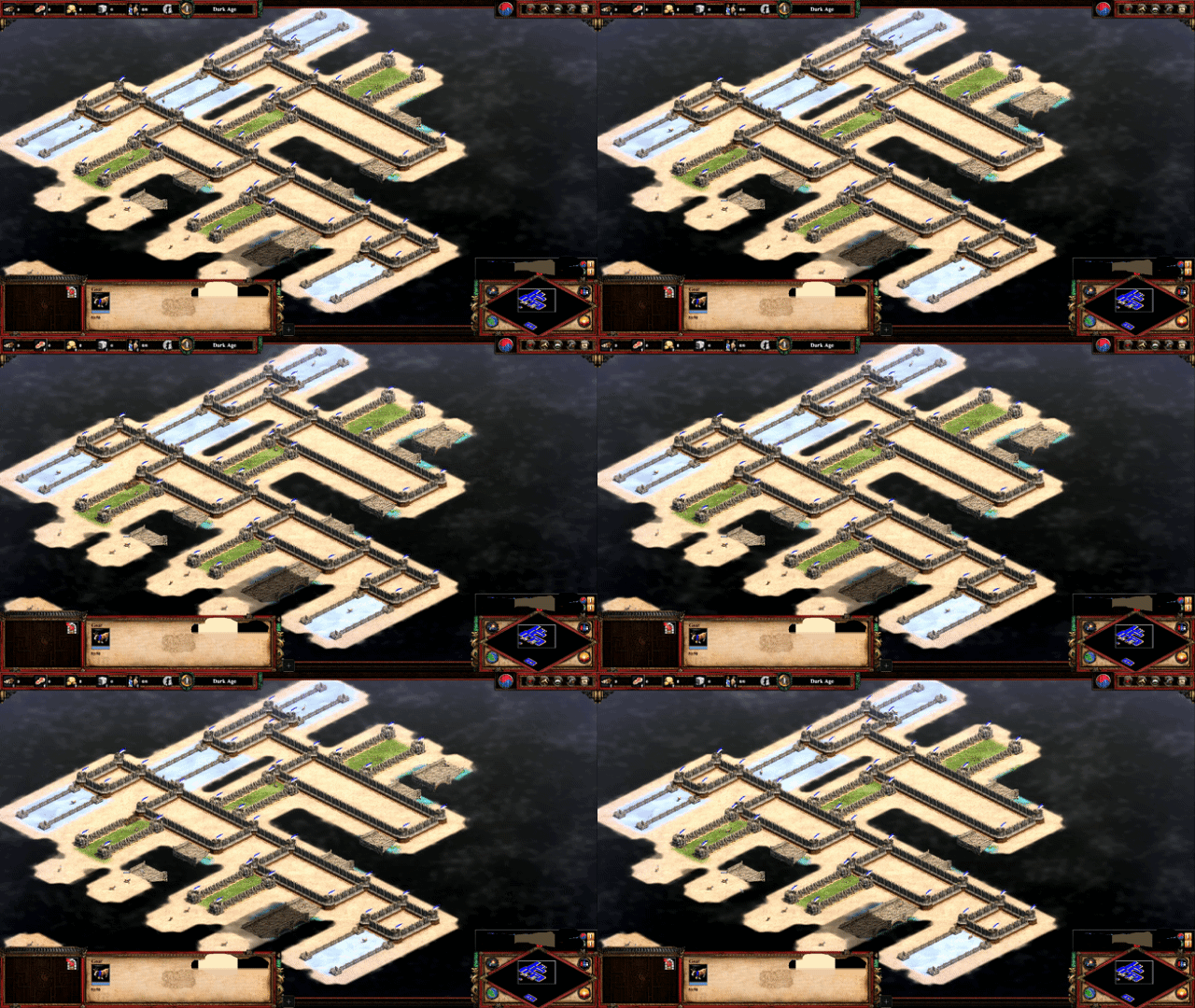
There are videos of De Wynter’s goat-powered LLM in action on his GitHub page. To the casual observer, the processes look completely baffling, which de Wynter reckons demonstrates his point.
The processes going on here are, fundamentally, those which power tools like ChatGPT, Claude, etc. But because the fundamentals are goats and grass rather than natural language, it prevents observers from perceiving the resulting behaviours and output as human.
“The point of the paper is to formally show that we anthropomorphise too readily, and that sometimes the claims we make with regards to LLMs capabilities are too strong,” de Winter said, going on to add that. “This is why I used the goats: there are things which make the LLMs what they are in themselves (i.e., the relationship between weights as defined by some operation), and there are things which make them what they are perceived as.”
The reason this is important is that assuming LLMs have human-like properties without demonstrative proof could lead us to all manner of problems, such as in scientific research. In his paper, de Wytner says he has peer reviewed more than 300 computer science papers in the last two years, finding that over half of them began with the assumption that LLMs have human-like traits.
“I propose that we need to stop assuming that LLMs behave like humans just because they were trained with natural language,” de Wynter said. “Instead, we should perform experiments that allow us to see LLMs as how they are, not how we believe they should be.”

2026 games: All the upcoming games
Best PC games: Our all-time favorites
Free PC games: Freebie fest
Best FPS games: Finest gunplay
Best RPGs: Grand adventures
Best co-op games: Better together