
PC gaming has a problem: high prices for a key component, due to an unforeseen surge of interest. We’re in the thick of it, with no light at the end of the tunnel just yet, as supply will take a very long time to catch up to the outsized demand.
Wait, haven’t we been here before?!
Sure we have, lots of times. We’re likely to get here again, too, as politicians around the globe have turned the semiconductor biz hewn of globalisation into something to be controlled and influenced by newly-minted factions with names you’d expect to see in a new Command & Conquer game: Pax Silica and WAICO.
Hey, when are they making another of those games? Anyways, global silicon gangs. They’re a thing now.
So, why is PC gaming so susceptible to the whims of global politics and trade? You don’t have to go far back through the annals of PC Gamer to find the last time we spoke of some huge problem in PC gaming that sounds awfully similar to the memory crisis we’re in today. Most recently, the closure and subsequent disruption of the Strait of Hormuz.
Our Jacob Fox recently spoke to various supply chain experts to gauge the impact of the US attack on Iran and subsequent closure of the Strait of Hormuz. He summarises it having an impact on Helium, sulphuric acid, PPE resin, aluminium, and naphtha. Each one used in some part of the semiconductor manufacturing process, affecting both chips and PCBs.
“You could see, in a worst case, allocation, scarcity-of-supply scenario where we’re going to be choosing to focus on AI infrastructure versus consumer needs,” Exiger SVP of Product Level Intelligence Derek Lemke told Jacob in May.
Prior to this action by US President Donald Trump, he imposed tariffs on a range of countries and goods, which in turn increased prices for the companies producing them and leading to higher sticker prices. That is, before being roundly rebuked by US Supreme Court and the funds returned.
Before that, the covid-19 pandemic. As the world came to a standstill and people moved away from offices and into their homes, demand for computers, consoles, standing desks, and exercise bikes erupted. Moreover, semiconductors were finally seen as a hot commodity by governments, and any weak links in supply chains were being interrogated, leading to the Biden administration and EU both announcing legislation to bring more cutting-edge semiconductor manufacturing to home soil.
Cutting-edge semiconductors that PC gaming is dependent on for many meaningful performance leaps over the years. PC gaming companies are some of the first to make the leap to bleeding-edge technologies, such as AMD when it rushed to utilise TSMC’s 7 nm process for a competitive advantage for its CPUs and GPUs.
Neither US or EU legislation seemed to do much alone, by the way. Trump renegotiated the CHIPS Act and EU member states called for a second spin on the EU Chips Act, with the first attempt now deemed by European Court auditors to be “overly ambitious.” Though both have played a part in refamiliarising politicians with semiconductor supply chains in a way that has led to some big and strange developments more recently. We’ll get to those shortly.
While that crisis was developing, PC gaming was in a more acute pickle due to outsized demand for graphics cards for cryptocurrency. At-home cryptocurrency mining had already had an effect on PC gaming with the first GPU shortage of 2017-18, though it was really from 2020 that things got bad.
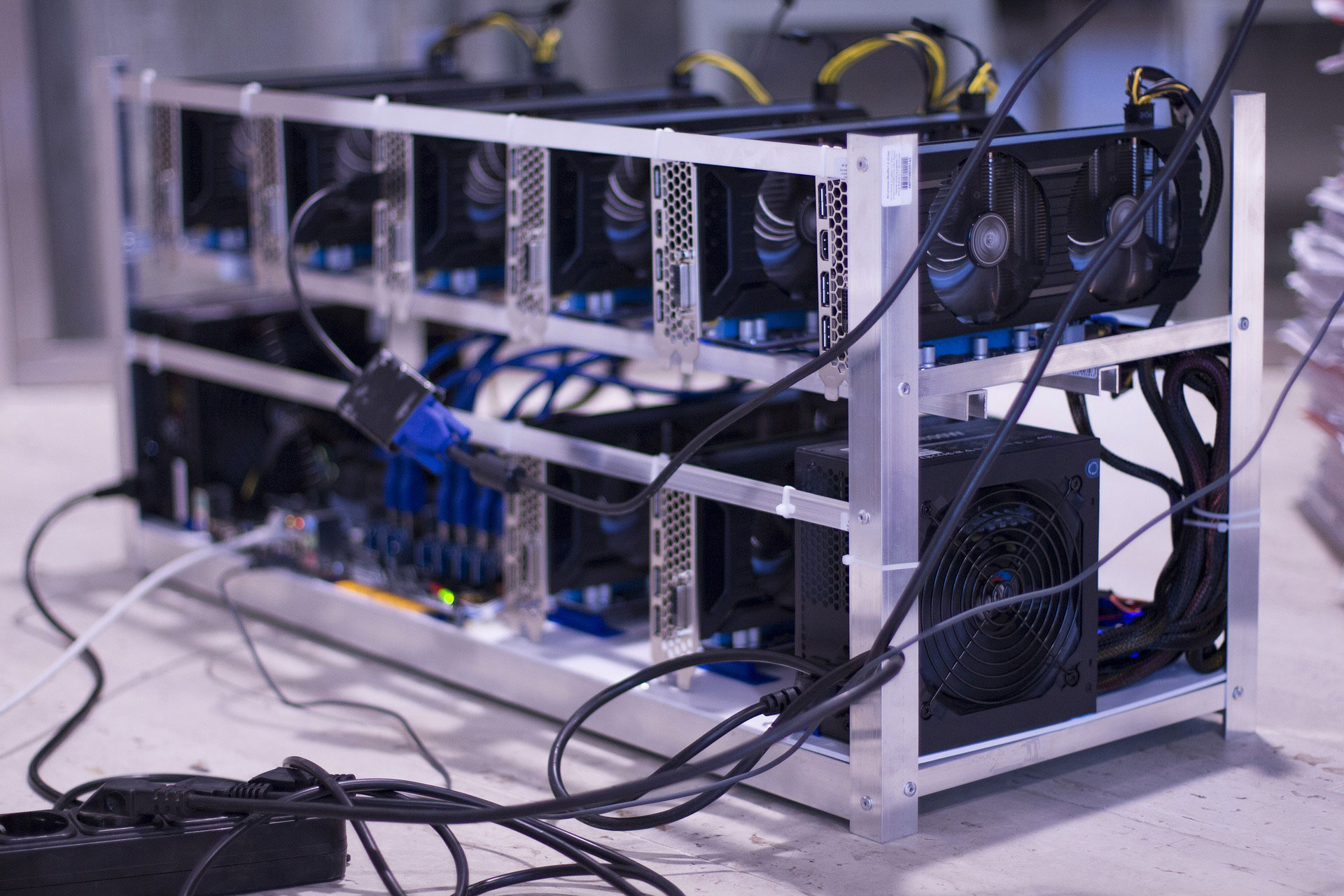
This continued through to 2022, when ethereum, the most popular cryptocurrency that could be mined on consumer-grade hardware (GPUs, rather than ASICs) shifted away from mining and turned to what’s known as ‘proof-of-stake’. Thus ending one of the worst periods in PC gaming that I covered personally—until today, anyways.
“If you break down to the DNA level of what goes into a chip, and you can look at the silicon that goes into the wafer, you can look at the metals and minerals that go into the circuitry, to some extent, every single one of those inputs has been hamstrung in some way,” said Dr. Goldsby, a supply chain expert.
“So here we’ve got demand, on the one hand, that’s just off the charts. And we’ve got the supply chain that is handicapped by virtue of getting access to materials, very constrained production capacity, and then slow transportation connecting the dots. You add it all up, and that’s where we are right now.”
Sound familiar? I’m not talking talking to Dr. Goldsby about the current memory crisis; this is from an article I wrote back in 2021 on why it was so difficult to buy a graphics card at that time. It’s about the increase in demand from cryptocurrency miners at the same time as covid-19 supply issues. These are similar forces, the same patterns, that lead us to the mess we’re back in again today.
I’m preaching to the choir. PC gamers having a solid understanding of the importance of supply chains and semiconductor technologies, it seems even exceeding many politicians, because it directly affects them. These things have an impact on their hobby, both good and bad, from better-performing processors to today’s inflated prices.
Back to the present day, and we’re looking at increased demand from AI, datacentres built out on an enormous scale (that’s very unpopular, for good reason), and a reliance on three (excluding the latest Chinese wildcard, CXMT) major memory companies that have often appeared to resist large-scale plans for new facilities for producing and packaging memory chips to counter sudden increased demand due to fears of an oversupply and crashing prices.
Despite some amount of unpopularity with the public for how AI models are trained, run, and their output, governments are betting their countries’ economic growth on AI. Datacentres are seen to be of an outsized import to a country’s national interests. Take the UK government, for example, which is labelling these ‘Nationally Significant Infrastructure Projects (NSIP) and rolling out new legislation to avoid parts of the otherwise lengthy planning process. You don’t want a datacentre whirring by your house all hours of the day? Well, tough.
All leading to political action on supply chains that spans continents, not countries. As I’ve been looking into the forces that manipulate the global semiconductor industry, I’ve stumbled across one recently formed organisation that hopes to have an impact on that very same thing: Pax Silica.
Yeah, it’s really called that. They even have a motto: “Securing the silicon supply chain.”
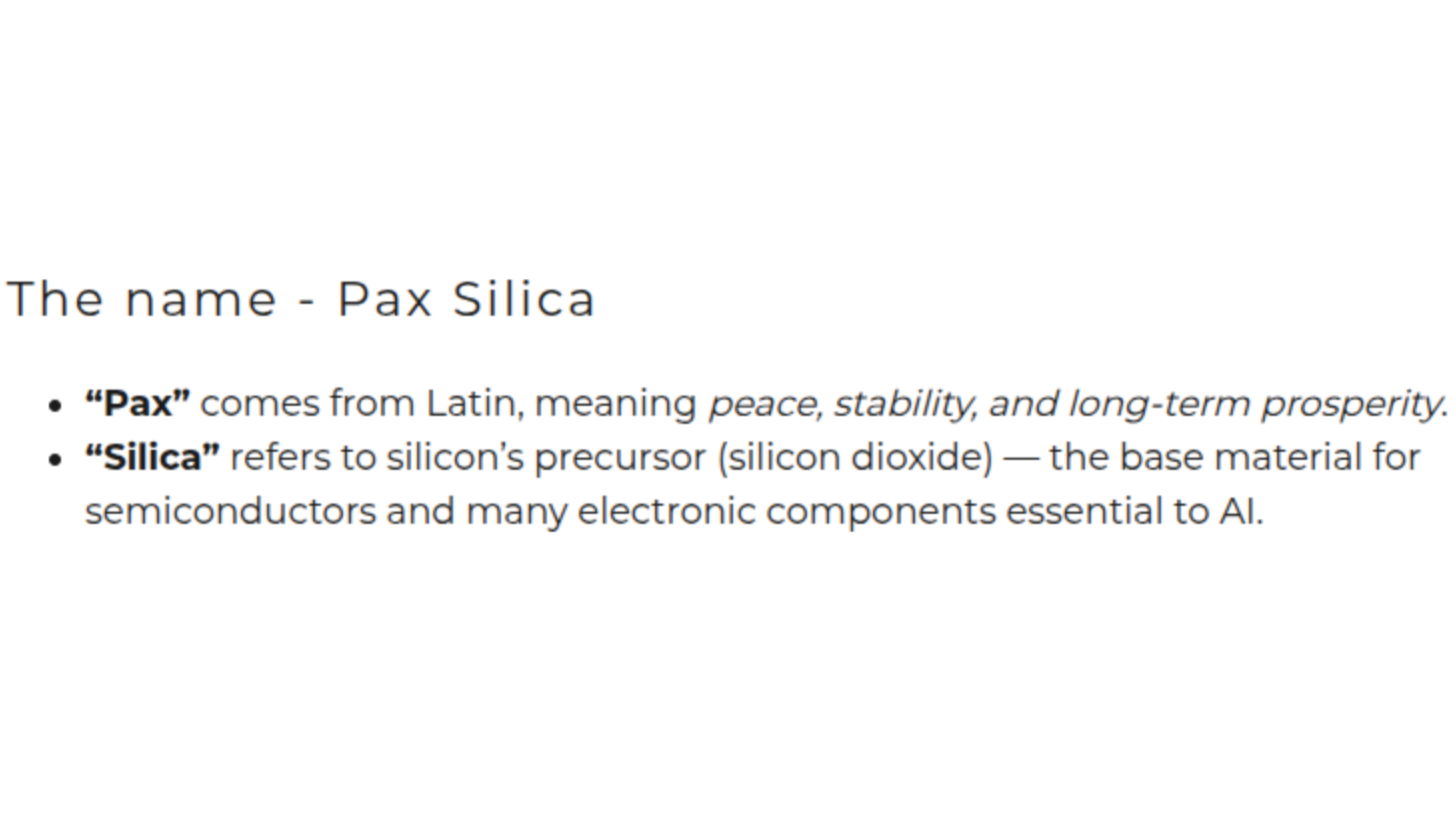
Where else could a name as lofty and Roman come from other than the United States? Organised by the US Department of State, but signed by 24 countries, many of whom joined in December, 2025, the Pax Silica is an organisation that intends to secure “AI and supply chain security” and to advance “new economic security consensus among allies and trusted partners.”
If the 20th century ran on oil and steel, the 21st century runs on compute and the minerals that feed it.
Jacob Helberg, US Under Secretary for Economic Affair
Of the many countries involved in the agreement—including the US, EU, South Korea, India, Israel, UK, Singapore, Philippines, Netherlands, Japan, and Qatar—the powerhouse of global semiconductor manufacturing, Taiwan, is only a “non-signatory participant”.
“If the 20th century ran on oil and steel, the 21st century runs on compute and the minerals that feed it,” says Jacob Helberg, US Under Secretary for Economic Affairs. “This historic declaration hails a new economic security consensus ensuring aligned partners build the AI ecosystem of tomorrow—from energy and critical minerals to high-end manufacturing and models.”
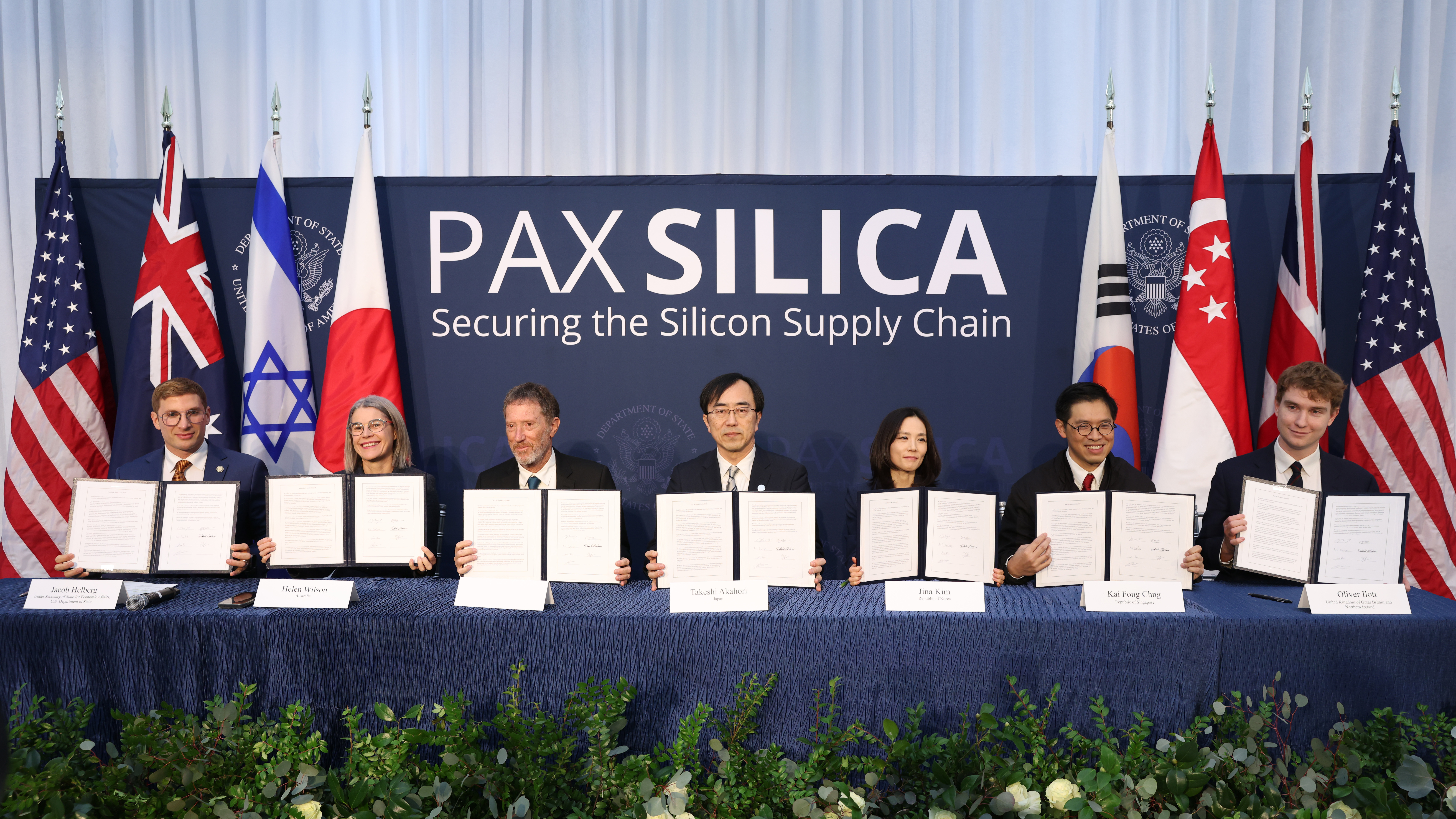
The idea being that frontier foundation AI models, semiconductors, infrastructure, manufacturing facilities, minerals, and the energy to run the lot are to be shared between signatories, and signatories are expected to collaborate on the next big thing.
There’s a strong sense of addressing national security and righting wrongs in the name of “fair competition” throughout its founding documents. Nations are expected to coordinate responses to “overcapacity and dumping so that supply chains remain secure, resilient, and innovative over time” and “protect sensitive technologies and critical infrastructure from undue access or control by countries of concern.”
You start to see where there’s some tension coming in, right? It’s not all about building fiber-optic cables to connect the world together in one big livestreamed kumbaya singalong.
There’s more tension bubbling around Pax Silica, too. What of the countries that didn’t sign up to it? On July 19, 2026, some of them announced their own organisation with a very similar sounding brief: The World Artificial Intelligence Cooperation Organization, or WAICO, stationed in Shanghai.
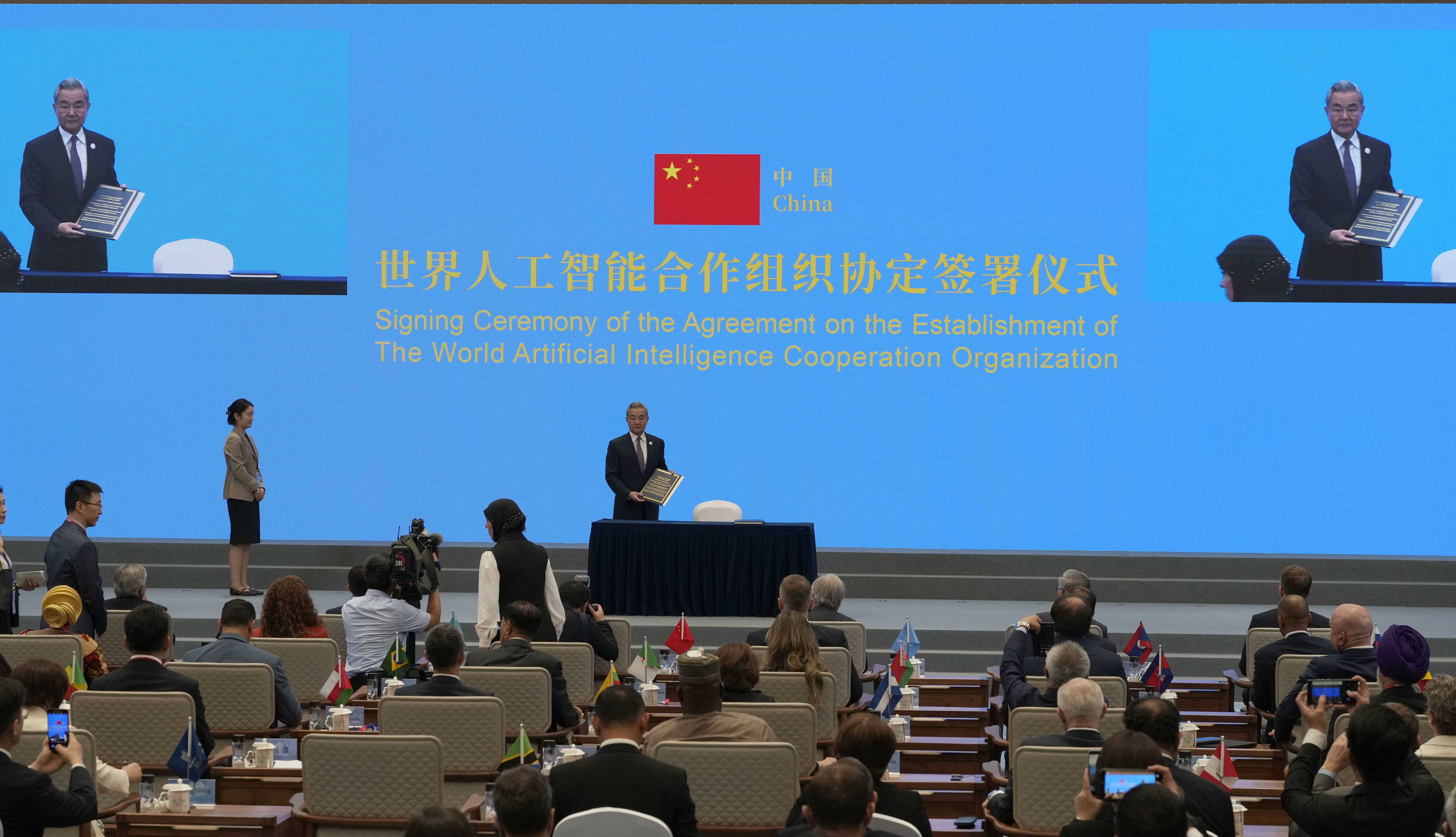
WAICO aims to be a cooperative agreement on AI, computing, and sharing frontier AI models among members that may have limited access to their own or other key players’, such as those made by large US companies. WAICO was originally floated by China, and counts Russia among its backers, but says it is operating in the interests of the ‘Global South’, which includes many developing nations, and BRICS, though India is a BRICS member and a signatory of Pax Silica, not WAICO. Kazakhstan is oddly in both groups.
Essentially, you have the US-backed faction on one side and the China-backed faction on the other. Two rival factions trying to control the flow of chips and advancement of AI models across the globe. Both sides want to play a pivotal role in shaping AI and tussling with one another over whose vision for the future is best.
It’s been reported in the past couple of days that the US is preparing to tell countries they must pick a side in this, too, with Reuters reporting countries could be barred from the US-led faction after having joined the one in Shanghai. Someone better tell Kazakhstan, then.
It’s all politics at the end of the day, but politics that play a role in how viable our own hobby remains. Trump’s tariffs are a prime example of when politics interfere with PCs, as are efforts to build more chips on US soil, even if costs to produce said chips are subsequently higher as a result.
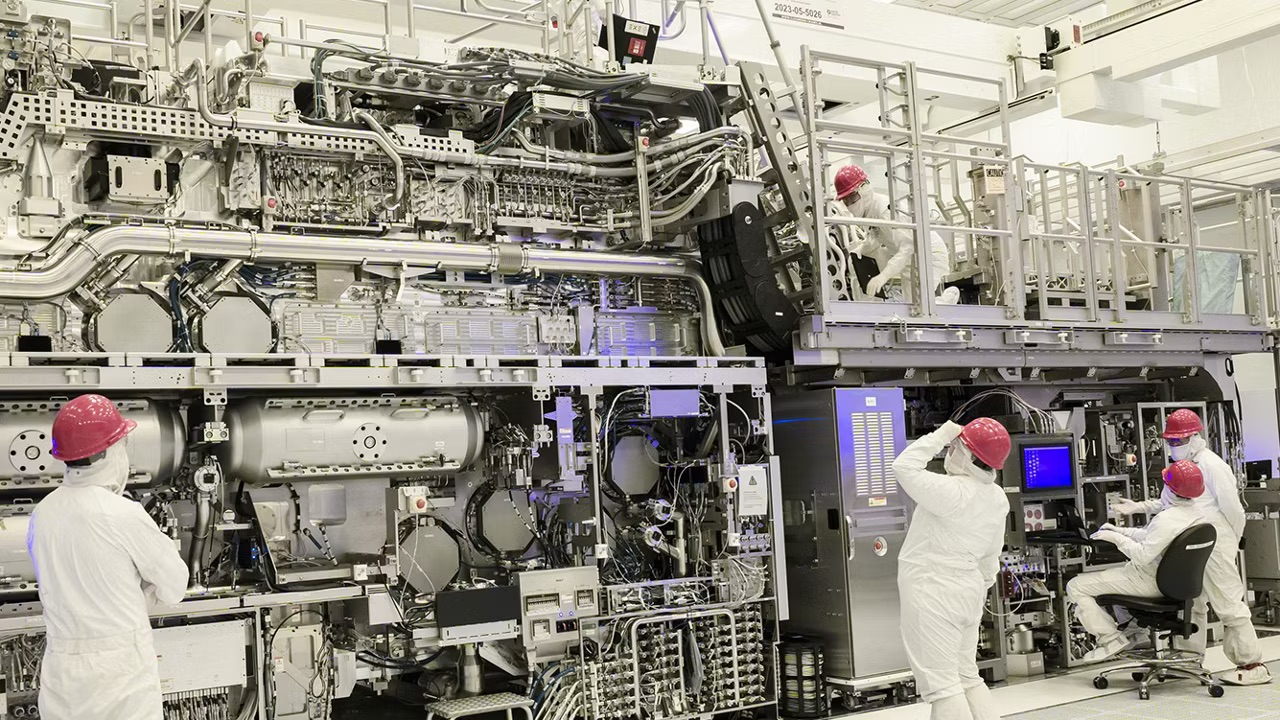
PC gaming is a tiny speck being blown this way and that by these gargantuan powers, riding the global semiconductor trade that operates on talent and resources moving across the globe. When it comes to the affordability or availability of cutting-edge semiconductors, it’s clear that nations are thinking plenty about AI capacity and a lot less about everyday consumers.
Neither group’s messaging appears to take much heed of arguments against another technological arms race, which is sure to further damage the environment and use even more energy than it does already today. These are two groups that feel they can’t take their foot off the gas and let the other ‘win’, but as a result will lead to us all losing to climate change in the long run.
So, if you’re hoping the pressures that led to the memory crisis would ease as more capacity came online, that may offer short-term relief, but we’re not out of the woods yet. It looks like we’re only just kicking into a new gear when it comes to resource guarding semiconductors, fabs, and rare earth minerals—and all in the name of AI. Ugh.