
The White House, the epicenter of power in the most powerful nation in human history, has rolled out a new online arcade on its website. And yes, it is every bit as racist, repugnant, and creatively bankrupt as you’d expect.
We’ll set aside the question of “why?” for now and get straight to the games, beginning with Flappy Bill, a game in which you fly a bald eagle down the National Mall. It’s not clear whether the bird’s name is actually Bill because it’s also carrying a bill, which my young years of being exposed to Schoolhouse Rock from across the border taught me is part of the US lawmaking process, or at least used to be before they decided that having the president do everything by fiat is more efficient or something. In any event, it’s an entirely unremarkable Flappy Bird clone, innocuous but about as much fun as tying a shoelace.
The tone takes a hard turn to the right with the next game, Build the Wall: Zombie Border Siege, a Tetris knock-off where you’ll “protect the border from the coming horde.” To ensure there’s no misunderstanding the nature of this horde, the game’s backdrop is a retro-future take on the sun setting over a barren desert—and in case that’s too subtle, there’s also a sign that says “Southern Border.”
One notable thing about this one is that unlike actual Tetris, the lines don’t disappear when they’re completed. Instead, they just stack up until they reach the top, at which point it’s inevitably game over no matter how neatly you’ve arranged things. A slow-moving line of “zombies” moves across the bottom of the screen, and they are capable of getting past your wall if you haven’t built it high enough—but “high enough” is literally two stacked tetrominoes, after which nothing can get past. So I’m not sure what the point is there, except to be really racist and xenophobic, I suppose.

Moving on: The third game in the White House Arcade is called Rio Run, a recreation of a “border patrol along the Rio Grande” based on the ancient classic Snake. As a balding white guy in a suit, you pick up brown-skinned people one at a time, each of whom joins a train behind you wearing shackles and an orange jumpsuit. Once the game ends, when you run into a wall or your train of prisoners, they’re all deported and you’re encouraged to try again. Lovely.
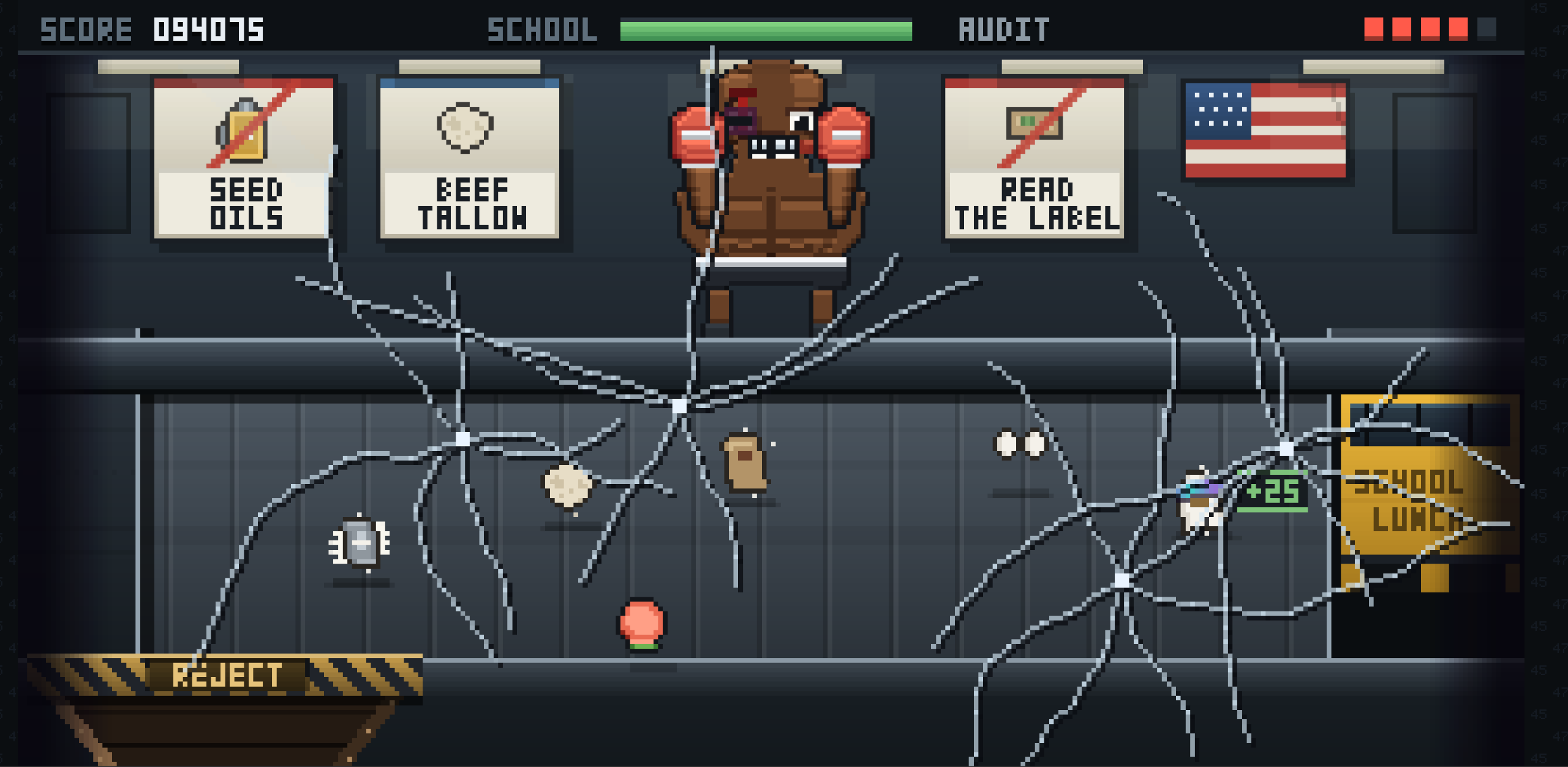
I don’t really know what to make of the fourth game. Supply Line, as it’s called, charges you to “sort the school line to make America healthy again” by letting ‘good’ food ride a conveyor belt to the school lunch box, while chucking ‘bad’ food—anything with coloring, additives, sealed packages, or seed oils—into the “reject” box.
This one was a little tricky at first because the low-effort graphics make it difficult to tell good food from bad (as the concept is envisioned by Robert F. Kennedy Jr), but what’s really bizarre is the muscular Black man in boxing gloves standing in the background. Every time I let a bad bit of food slip past, he punched the back of my monitor. Four punches and it was game over, although oddly enough he’s the one who took the actual damage.
Also, reading labels is apparently bad, according to a sign with a red strike through it. Ain’t that America? For you and me, baby.
The fifth and final game on the White Hours Arcade tour is Trump Savings Tycoon, a game about filling your kids’ Trump Accounts, which are basically retirement savings accounts for children, backed by money from various super-wealthy individuals like Jensen Huang and Michael Dell who may or may not have anything to gain from big-money sycophancy.
This game involves simply clicking on various money-esque objects with a net as they fly across the sky. It’s maybe the simplest of the bunch mechanically, but the clicking is extremely imprecise so it doesn’t take long before three objects are missed and it’s game over.
More interesting to me is the background, which features the Reflecting Pool (a perfectly lovely shade of blue, unlike its real-world counterpart) and a massive construction crane looming over the Washington DC skyline, presumably indicating optimism about the president’s planned ballroom/bunker. There’s also a small convoy of what appears to be flying police cars that goes soaring across the sky every now and then. I have no theories about what that might be about.
In case it wasn’t sufficiently clear, these things are universally bad, both conceptually and in execution: If you’re going to rip off the world’s most famous stacking game to promote your racist agenda, for instance, you should at least make it play like that game. It’s an astonishingly lazy effort, and I can’t shake the feeling that all of these games were vibe-coded, maybe by some DOGE hanger-on they found hiding in the bathroom.
The obvious question is, as noted earlier, is why? Who are these games for? I think the answer in one sense is that they’re for no one in particular, but are instead just another wave in the flood of sewage pumped out every day by the US president and his administration. Over the last couple years, the US government has posted numerous gaming-related memes, video clips, and AI generated images to promote its leader and his agenda.
But more broadly, this effort is targeted at the young male gamer demographic, at least in part to leverage the political influence it first demonstrated during the Gamergate harassment campaign.
George E. Osborn, author of Power Play: Videogames, Politics, and the Battle for Global Influence, wrote on his Videogames Industry Memo blog (via The Guardian) that “the content works because it does what a lot of good social content does. It riffs on widely known popular culture to get cut through in the way many popular memes do. It has a chaotic, anarchic tone which suits the channel it’s in. It is transgressive in a way that delights the administration’s supporters and infuriates its rivals. And it feels all the more edgy because the formerly stuffy White House social channels have been turned into a place where this kind of stuff circulates freely.
“A big chunk of the modern political right in America emerged from Gamergate. The hate movement was brought into the political fold by Steve Bannon and Breitbart after it showed how it is possible to wash extreme talking points into the mainstream political environment. Its members became online ‘shock troopers’ for Trump, as well as becoming foundational figures in the alt-right and nuttier fringes like QAnon. And as they’ve grown up, the almost entirely young men who made waves back in 2014 are now in positions of power on the right. This allows them to shape the online narrative, encouraging them to reach a fresh generation of men through an increasingly fragmented social media ecosystem that allows transgressive macho ‘manosphere’ content to trend.”
The US government shows no sign of easing off on these behaviors. Posts on X promoting the new arcade site include animations using the Xbox, Nintendo, and Sega logos, the latter of which was probably chosen because it morphs well into “MAGA.”
CAN’T STOP WINNING. 🎮Build the wall. Deport. Fill a Trump Account. LIVE – PLAY NOW 📲 https://t.co/qIR69AxSnm pic.twitter.com/2nr2jG1ZRgSeptember 3, 2026
While the owners of properties used in past posts have thus far opted to stay silent, The Tetris Company did obliquely suggest that it might take a more aggressive approach. Following an Instagram post in which the company said “we believe in the power of connection and bringing people together, not dividing them,” it added, “PS: The Tetris Company was not involved in the creation of Build the Wall. PPS: We take copyright infringement very seriously.”
As completely crappy as all of this is on every possible level, it seems likely there’s more to come. A currently unoccupied sixth game window on the White House Arcade page says “a new adventure awaits,” and encourages interested followers to “stay tuned.” I’ve reached out to the White House for comment on the new virtual arcade and will update if I receive a reply.
2026 games: All the upcoming games
Best PC games: Our all-time favorites
Free PC games: Freebie fest
Best FPS games: Finest gunplay
Best RPGs: Grand adventures
Best co-op games: Better together