
Fast-paced. 3D Platformer. Parkour. First-Person. Racing.
Those are the tags affixed to the Steam page for Stuntboost, a game that I’ve had trouble summing up with a clean label when asked about it. Stuntboost is a skateboarding game that sometimes features a car, a platformer with a speedometer, an ode to those shrunken bedroom maps popularized by early FPS modders.
It’s also, quite easily, my favorite game of 2026 so far.
Yet, Stuntboost could’ve easily slipped under my radar. It’s been out for a month and hasn’t made a big splash on Steam—it’s rated “Very Positive” with 253 reviews. I only found it through a friend’s recommendation, and even then, the art style didn’t immediately suggest it was my thing.
Stunboost’s toy fingerboards and cardboard circuits give the impression of a chill, Hot Wheels-adjacent racer your child could enjoy, but unless that child is accomplished with a mouse and keyboard, that ain’t happening. This is the only skateboarding game with a warning that suggests you play with a mouse, and it’s immediately obvious why.
Once you learn a few techniques, Stuntboost looks like this:
And this.
And this.
Despite its choice of vehicles, this thing’s for FPS movement sickos—an exercise in precision camera control and first-person platforming. It’s essentially a three button game (jump, crouch, grind) about gaining and maintaining speed. Many of its tracks are non-linear obstacle courses that ask you to find your own way across, and the devs actively encourage looking for shortcuts.
I’ve been obsessed (a word I’m not using lightly) with Stuntboost’s 40+ levels for weeks now, replaying tracks and cutting seconds off my times to score the top medals. And once I have those medals, I get to work shaving hundredths of seconds to take the number one spot on my friend leaderboard. Oh man, this is a dangerous game for a friendly rivalry. I now live in fear of a Discord DM informing me that the PB I spent hours honing has been shattered.
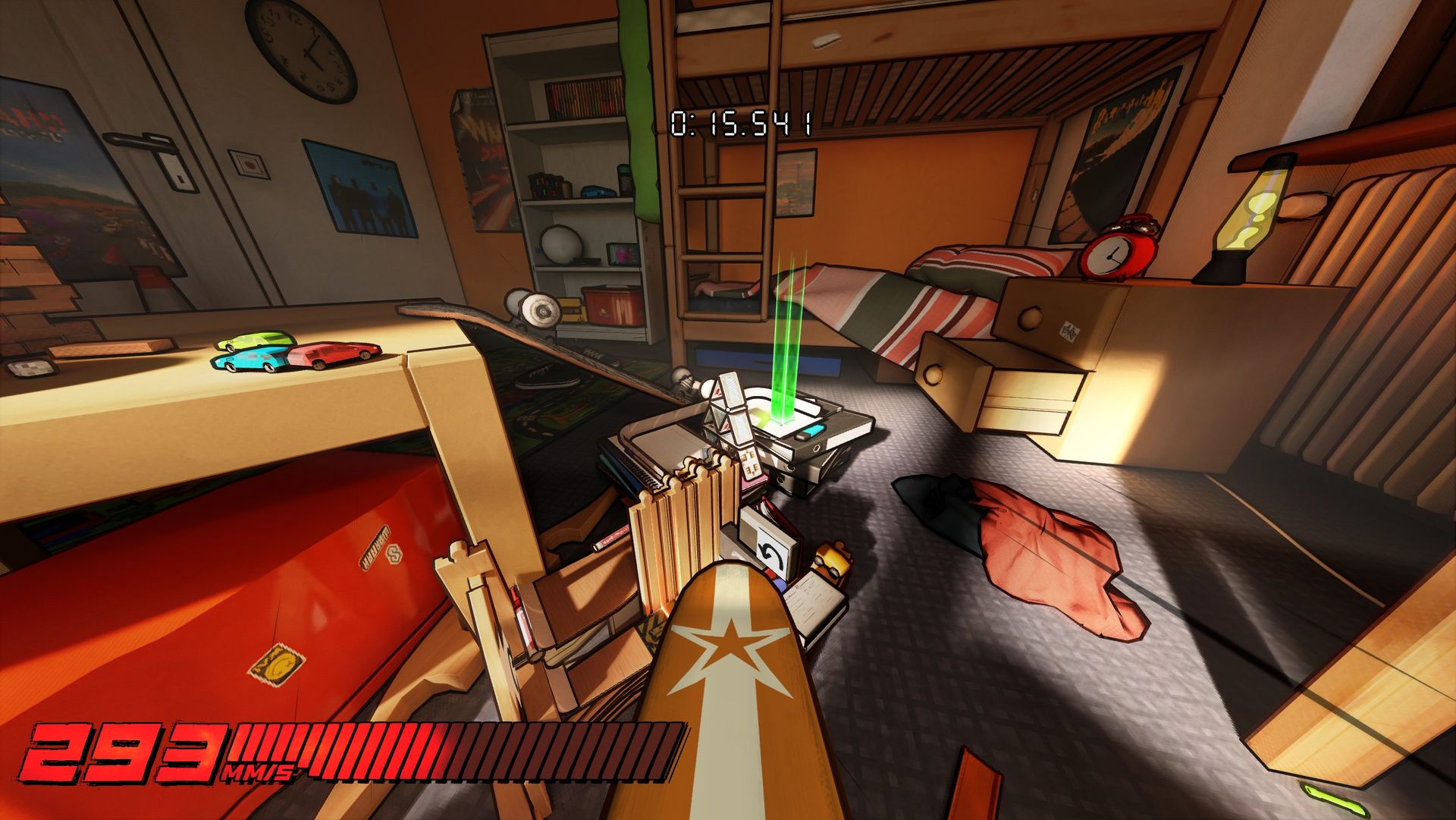
But I honestly welcome the excuse to replay tracks, because Stuntboost’s movement is fundamentally thrilling, and its maps are masterfully crafted with standard and absurd routing in mind. Its wide ramps, massive jumps, and daring speeds remind me a lot of Trackmania—my favorite racing series—but more specifically, a subset of “full speed” community tracks that never ask you to brake.
Stuntboost also nails a lot of little quality-of-life features that you rarely see in games with way larger budgets. Information about a track is revealed in stages: I can’t see friends’ times until I’ve beaten the track once, and global leaderboards are locked until I get the diamond medal. The ghost of my best time appears automatically, but I can also turn on the ghosts of my friends or anyone else on the leaderboard. I can even watch anyone’s replay in full as long as I’ve discovered the same shortcuts they used—a smart touch (possibly inspired by Neon White) that prevents spoilers and entices me to search for what I’ve missed.

“It’s like Neon White”
- Layered leaderboards
- Shortcuts
- First-person platforming
BUT: I never finished Neon White because the levels got overwhelming. Juggling cards and shooting mandatory targets sometimes made levels feel strict and suffocating. Stuntboost is simpler, faster, and improvisational.
Watching replays is a big deal, too, because it’s primarily how I picked up on community techniques that opened my third eye: varial kickflips, grind hopping, speed storage. Every sloped surface is an opportunity for just a bit more speed and every ramp-shaped object—be it a plate, playing card, or three-ring binder—is a springboard that could send me across the map. The variability of a single track can be staggering.
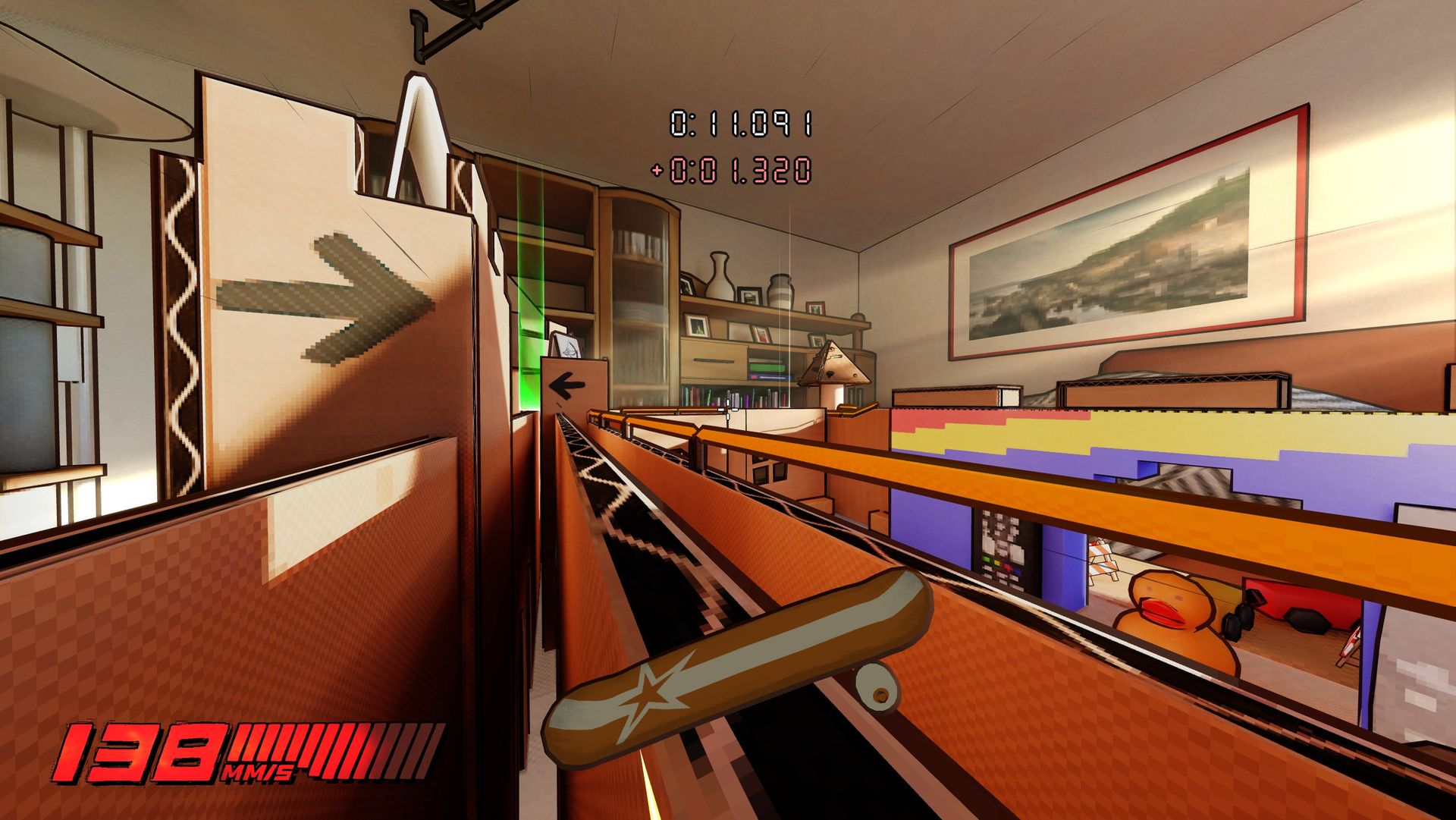
Later worlds (which visit other rooms of the same house) expand beyond the skateboard with car levels that revolve around drifting, free roam scooter levels with S-K-A-T-E collectibles, and a longboard that can’t jump. Some of these are just a neat palate cleanser, but the car levels are particularly spectacular for how they force me to relearn how I turn and, eventually, hit sick drifts that’re impossible on the skateboard.

“It’s like Trackmania”
- Ghosts
- High speed
- Wild tracks
BUT: Trackmania is a proper driving game, and Stuntboost is its own thing. Where Trackmania demands braking and cornering to improve track times, Stuntboost has no brake, lets you turn on a dime whenever, and encourages max speed at all costs. If I made a Trackmania, it’d be just like this.
Every level has a hidden tape that unlocks a free cam (excellent for scouting) and contributes to unlocking a set of bonus levels. I haven’t played all of these yet, but I’m told there’s a huge tower gauntlet with a fierce leaderboard race. There’s also a speedrun mode that times a run of the complete game, board skins, and a daily challenge.
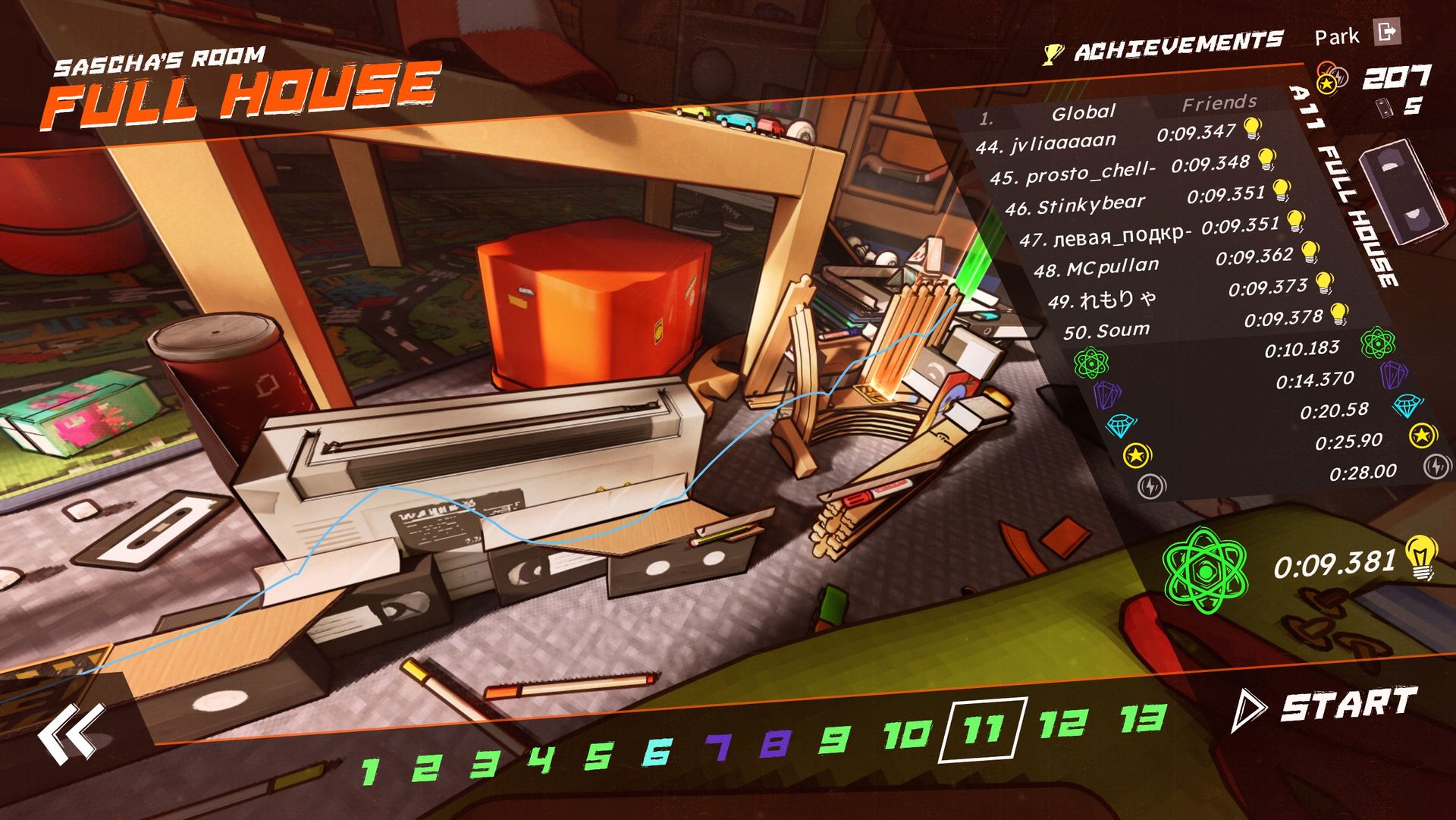
I am in awe of how unique and fun and fully-featured this thing is, and for $7. Frankly, it’s an injustice that Stuntboost isn’t one of the year’s big indie success stories, but that’s nothing new. The indie games that click for me always gravitate toward interesting movement mechanics or use of physics, and that rarely intersects with what PC gamers are currently going wild about (deckbuilders, autoshooters, and city builders mostly).
I’ve played lots of those—what I want are more games that make me feel alive and dangerous. Stuntboost has me vibrating in place, leaning into high-speed turns, and cursing a god I don’t believe in. It’s an intoxicating rush on a level I have not experienced before, and you should absolutely play it.