

Indie-oriented digital storefront Itch.io is beginning to push back against the rising flood of AI, announcing on social media that it’s “deleted a couple terabytes of AI slop” and made it easier for users to filter out games made with generative AI.
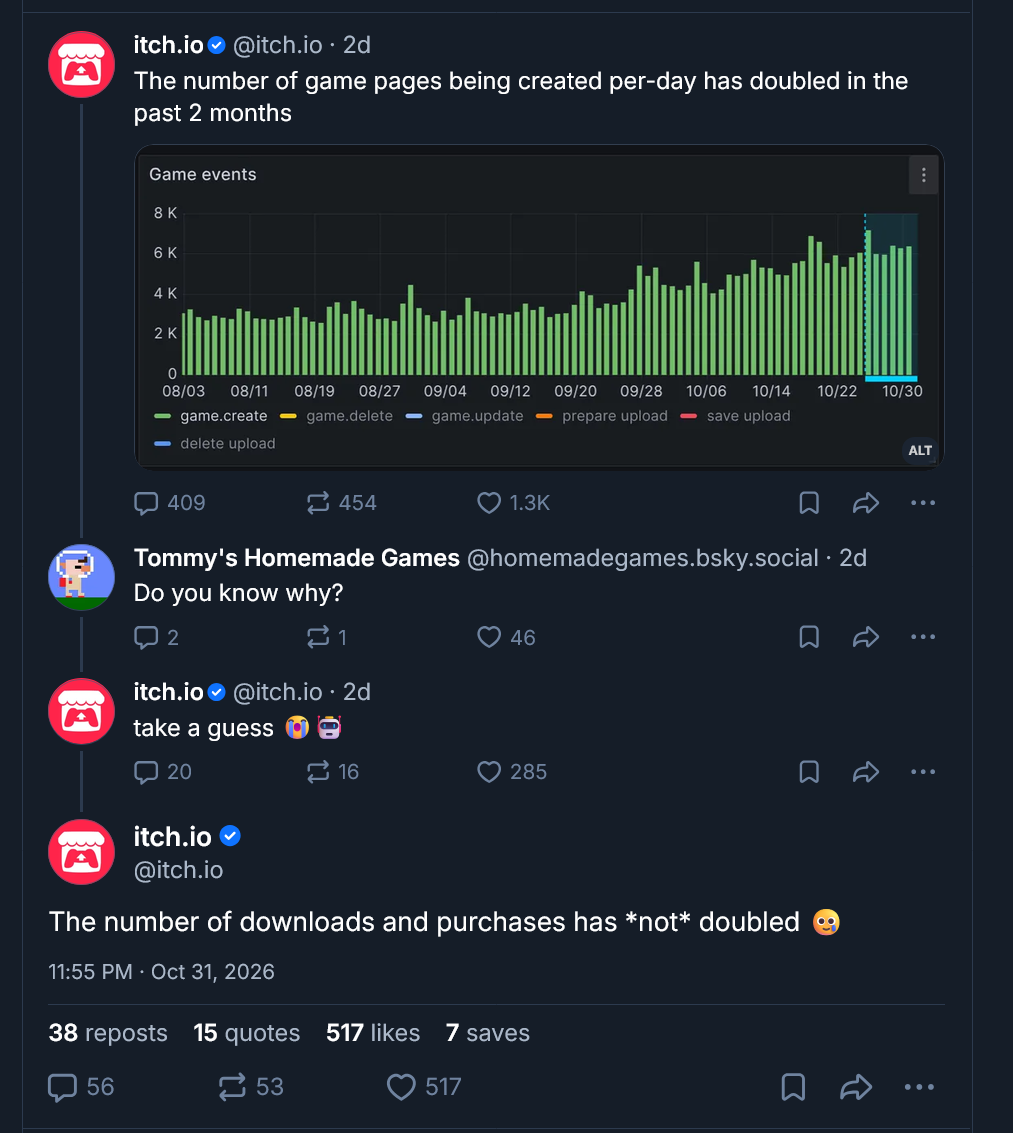
A few days after Valve admitted that Steam has a problem with AI slop and game cloning, Itch.io chimed in to say it’s experiencing something very similar: The number of game pages being created every day on the storefront has doubled over the past two months.
Itch.io didn’t provide a reason for the phenomenon, but it’s not hard to figure out: When one Bluesky asked why it was happening, Itch.io replied “take a guess,” accompanied by crying and robot smilies, and then added that “the number of downloads and purchases has *not* doubled.”
Now it seems to be moving to action. “Just deleted a couple terabytes of AI slop,” the storefront posted last night. “Just because you can upload 10 terabytes of poorly optimized AI generated models doesn’t mean you should upload 10 terabytes of poorly optimized AI generated models.”
The account also linked to Itch.io’s guidelines on “uploading excessive amounts of automatically generated or AI-generated content,” which says that while content created by generative AI “can be useful or interesting, do not use automated systems to mass produce product pages. We will consider this spam and may remove your pages from our browse and search pages.”
The guidelines apply to, but are not limited to:
- Games or projects that are predominantly created by algorithms or AI with minimal human intervention
- Content that is randomly generated with no or minimal curated design
- Multiple iterations of essentially the same content that are generated by AI or algorithms
Like Steam, Itch.io requires developers and publishers to disclose their use of generative AI in their games. That disclosure requirement has now been expanded from game assets to “the tabletop (aka physical games), books, comics and soundtracks categories,” all of which now require disclosure.
It has also added new browsing and search filters on the site, so users can exclude some or all use of generative AI.
The tabletop (aka physical games), books, comics and soundtracks categories on itchio now require completing an AI disclosure in order to edit or create your page. These join the game assets section which has required disclosure for the past 2 years.
— @itch.io (@itch.io.bsky.social) 2026-11-03T17:57:04.445Z
The “No AI” tag page cuts straight to it:

Itch.io’s action isn’t likely to stem the tide of AI slop that’s engulfing the world of gaming. Apart from the fact that it represents a very small percentage of a market dominated by Steam, the simple truth is that AI slop is easy to churn out in overwhelming quantities—that’s what makes it so attractive to people who care less about creation than they do about making a few bucks on a lucky swing of the bat.
But it is action, and I think that’s important: While some argue that mandatory AI disclosures have the potential to harm developers, the gen AI geyser is unquestionably doing harm right now, to users, developers, and the industry as a whole. Unless and until that changes, proactively excising the worst of the slop torrent and making it easier for gamers to avoid the mess entirely is the least that online storefronts can do.

2026 games: All the upcoming games
Best PC games: Our all-time favorites
Free PC games: Freebie fest
Best FPS games: Finest gunplay
Best RPGs: Grand adventures
Best co-op games: Better together
